There is something about generative AI that seems to bring out the detective in people.
Give them a piece of writing and, instead of asking whether it's interesting, useful, accurate or worth reading, they're increasingly tempted to ask another question: Was this written by AI?
And if an AI detector comes back with a suitably impressive percentage – 87 per cent AI! 96 per cent! – there's often an air of triumph about it. Gotcha. You didn't really write this. You cheated.
Now Anthropic has given that debate an interesting new dimension.
The company is introducing invisible watermarking into text processed by Claude. Unlike the AI detectors we've become familiar with, which attempt to identify characteristics associated with machine-generated writing, Anthropic's approach introduces a statistical pattern into Claude's choice of words as the text is generated.
You can't see it. Copying and pasting doesn't necessarily remove it. Some editing may not remove it either. Anthropic says a detection API is coming. Cue the gotchas.
Except there's a fairly substantial problem. Detecting the watermark doesn't necessarily mean Claude wrote the text. It means Claude processed it.
You could write an article entirely yourself, pass it to Claude and ask for help tightening the prose or correcting the grammar, and the resulting text could contain the watermark. At the other extreme, you could give Claude a three-line prompt, take the 1,200-word article it produces, make a couple of cosmetic changes and publish it under your name.
Both could potentially carry Claude's watermark. Yet they represent very different relationships between the human and the AI.
Did you use AI?
Shel and I discussed this in episode 526 of our For Immediate Release podcast, published earlier this week, prompted partly by Anthropic's announcement and partly by an AI writing policy introduced by Clay, a software company based in New York.
During the conversation, I found myself making a distinction I've made before between AI-generated and AI-assisted writing. I think the distinction is useful.
If I tell Claude the topic and ask it to write an article, lightly edit the result and publish it, that's substantially AI-generated writing.
If I've developed the argument myself, researched the subject, worked out what I want to say and then used Claude to challenge my thinking, suggest improvements, identify gaps or help edit the finished piece, that's AI-assisted writing.
And then I heard myself say something else. "Who cares?"
I don't mean that authorship doesn't matter. Nor do I mean that there are no circumstances in which the use of AI should be disclosed. There clearly are. Academic work, examinations, competitions, journalism and some regulated environments are obvious examples. If the rules require disclosure, disclose. If someone commissions your personal expertise and you quietly subcontract the thinking to a machine, that's an ethical issue too.
But for a great deal of everyday professional writing, I'm increasingly unconvinced that “Did you use AI?” is a particularly useful question.
What are we actually trying to catch?
Suppose someone uses Claude to improve a report they've spent two days researching and writing. Is that AI-written?
What if Claude restructures three paragraphs? What if it suggests a stronger opening? What if the writer accepts half a dozen edits? What if they dictate their thoughts into their phone, give the transcript to Claude and ask it to turn those thoughts into a coherent first draft?
Or what if they use Grammarly and accept every suggestion it makes?
At what point did the human stop being the writer?
We can construct definitions for all of these things, and there are circumstances where doing so is useful. But I'm not convinced that applying increasingly elaborate labels to the process tells us very much about the quality, integrity or value of the finished work.
This is why I worry about the enthusiasm for AI detection.
The question “Did you use AI?” easily becomes an accusation. It encourages concealment and policing. It assumes that using the technology is itself the questionable behaviour.
A better question is: "What was your intellectual contribution?" That shifts the conversation somewhere much more interesting.
Writing is thinking
This is where Clay's AI writing policy comes in.
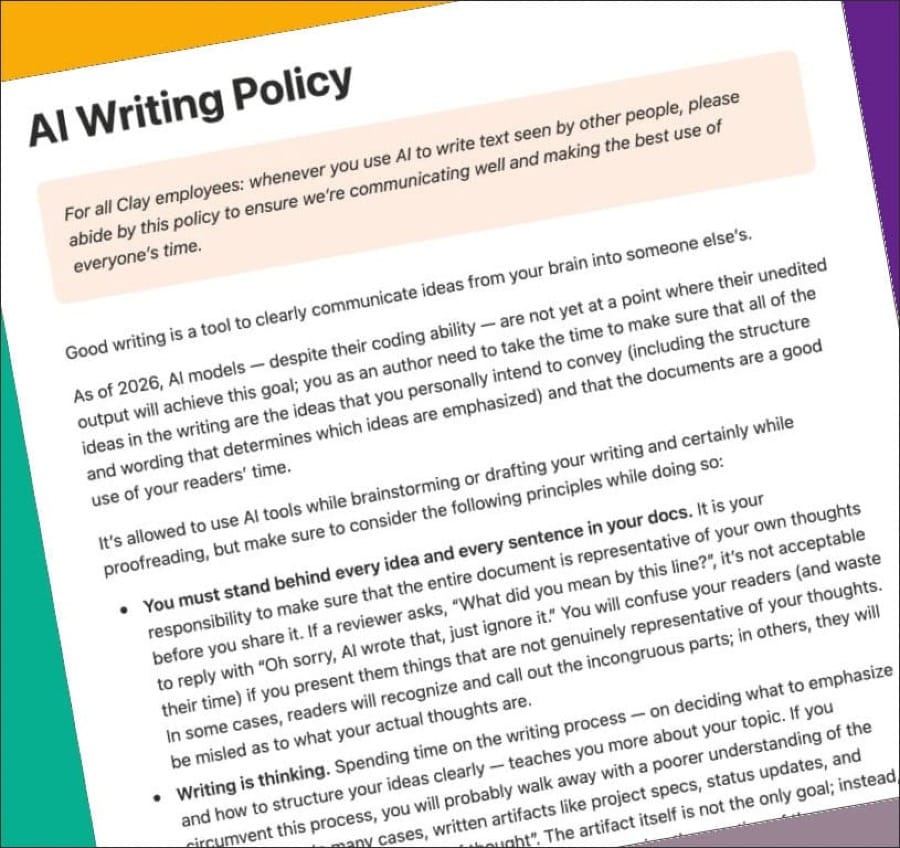
Its four principles are strikingly simple: stand behind every idea and sentence; remember that writing is thinking; spend more time creating a document than you expect someone to spend consuming it; and don't assume that longer is better.
That second principle deserves particular attention.
Writing is thinking. Anyone who writes regularly knows the experience of beginning with what seems like a perfectly clear idea, only to discover while trying to articulate it that the argument has holes in it. The act of writing forces us to organise ideas, make connections, question assumptions and decide what we actually mean.
Hand all of that to an AI and something important may be lost. But there's a qualification here that Shel raised in our conversation.
Shel and I are writers. Many of the people we encounter professionally are communicators and writers too. It's very easy for us to assume that everyone thinks by writing.
But they don't. An engineer, accountant or technical specialist may understand something deeply but struggle to explain it clearly in prose. Their thinking might happen through diagrams, calculations, notes, conversation or simply talking through a problem.
If that person records their thoughts and asks an AI assistant to help turn them into a clear email, is that intellectual laziness? I don't think so. In fact, it may demonstrate something we ought to value more highly: respect for the reader.
The reader matters too
This connects directly with another issue Shel and I discussed on FIR 525 earlier this month: workslop.
AI makes it extraordinarily easy to produce something that looks finished. Give it a thin prompt and seconds later you have three polished pages, complete with headings, bullet points and an impressively confident conclusion.
The problem is that the thinking may never have happened. Worse, the work hasn't disappeared. It has merely been transferred.
The person generating the document may have saved an hour. The five colleagues receiving it for review now have to work out what it means, check its claims, identify what's relevant and perhaps redo parts of it.
That's not productivity. It's shifting the cost of thinking onto your audience.
Which is why Clay's principle about standing behind every idea and every sentence strikes me as far more useful than attempting to determine what percentage of a document came from AI.
Did you think about this? Do you understand it? Did you check it? Is it accurate? Does it say what you actually believe? Is it worth somebody else's time to read? And if challenged, are you prepared to put your name to it and defend it?
Those questions matter whether Claude was involved or not.
A perfectly human piece of rubbish
There's another aspect of the AI-writing debate that sometimes gets overlooked.
Human beings have been producing dreadful writing for centuries. A badly argued, inaccurate, self-important 1,500-word article doesn't become valuable simply because we can establish beyond doubt that every word emerged from a human brain and keyboard.
Likewise, thoughtful work doesn't suddenly become worthless because an AI helped its author organise an argument or improve the prose.
Which brings me back to the question I blurted out, more than once, during the FIR conversation.
Who cares?
I care whether what I'm reading tells me something worthwhile. I care whether it's accurate. I care whether the author has thought about the subject. I care whether they've respected my time. And I care whether they're prepared to take responsibility for what they've put into the world.
So these are the questions that matter most:
- Is it accurate?
- Is it useful or interesting?
- Is it ethical?
- Does it show some originality?
- Does it achieve its intended goal?
I'm considerably less interested in whether Claude suggested paragraph seven.
The watermark that matters
Anthropic's watermark is technologically interesting, and there are good reasons for it. It provides a means of establishing that Claude has processed a body of text, and transparency around AI-generated content is becoming an increasingly important regulatory issue.
But it cannot tell us who did the thinking. And perhaps that's the limitation worth remembering if, as seems likely, watermarking becomes more widespread across AI models and detection tools become available.
We could use these technologies to fuel an expanding game of AI gotcha: scan the writing, find the signal, expose the culprit.
Or we could ask something harder. What did you bring to this? Where are your ideas? Did AI help you think, or did you ask it to do your thinking for you?
And can you stand behind the result?
Those questions don't produce a neat percentage score. But they tell us far more about authorship than a watermark will.
References:
- How Claude’s text watermark works (Anthropic, 14 August 2026)
- How Claude marks AI-generated content (Claude Support, August 2026)
- Anthropic's text watermarks signal new front in AI detection (Axios, 12 August 2026)
- We just instituted an official AI Writing Policy at Clay... (Varun Anand, Clay, on LinkedIn, 5 August 2026)
- FIR 526: Forget Anthropic’s AI Watermark. Can You Defend Every Sentence? (For Immediate Release, 17 August 2026)
- Good content is a judgement call, not a detection exercise (Studio6, 4 February 2026)
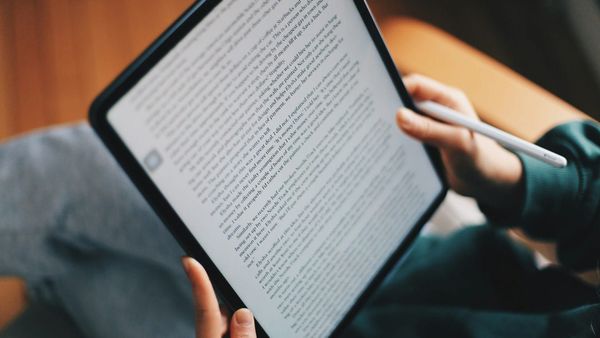
Photo at top by amir shahcheraghian on Unsplash.