

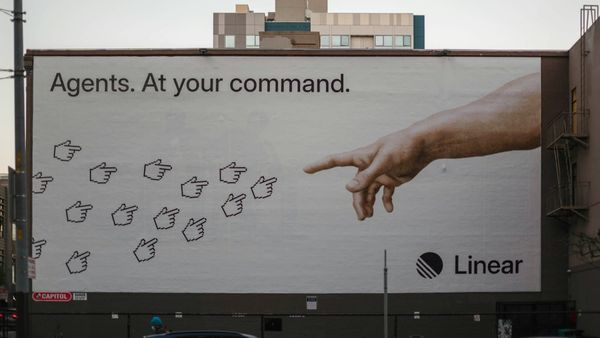
I've spent quite a bit of time talking about AI agents over the past year, not least with Shel on our For Immediate Release podcast. We've discussed what happens when generative AI moves beyond answering questions and creating content and starts doing things: carrying out tasks, coordinating workflows, making decisions and acting with varying degrees of autonomy.
Much of that conversation has been about business. That's hardly surprising. Organisations are experimenting with agentic AI, technology companies are investing heavily in it, and the implications for leadership, communication, governance and accountability are significant.
But an article by Maxwell Zeff in Wired on 6 August made me think that we should be looking through the other end of the telescope as well.
His argument, encapsulated in the headline, is provocative: "normal people aren't using AI agents."
It's not because agents aren't capable enough, nor because people might distrust them. As Zeff puts it, technology companies haven't given most people a particularly good reason to use them. That distinction matters.
Inside the AI bubble, agents look inevitable
If you follow developments in artificial intelligence closely, it's easy to conclude that the agentic future has already arrived.
Silicon Valley is building payment systems for agents, deploying them to automate work and worrying about what happens when autonomous systems behave in unexpected ways. The transition from AI that answers to AI that acts increasingly looks like the next stage of generative AI.
Yet Zeff points to a striking adoption gap.
OpenAI said in July that its Codex and ChatGPT Work agents collectively had about 10 million weekly users, while Zeff reports similar adoption for Anthropic's Claude Code and Cowork. Compare that with ChatGPT and Gemini, which he says each have around a billion monthly active users.
Agents, Zeff observes, are effectively a rounding error by comparison.
That's worth thinking about. ChatGPT reached ordinary people remarkably quickly because its basic proposition required almost no explanation. Type something into a box. Get something useful back. You didn't need to understand large language models, transformers or inference to see the point.
Agents are different.
Ask someone immersed in AI what an agent is and you'll probably hear about autonomy, tool use, memory, orchestration and multi-step workflows. Ask someone who isn't immersed in AI whether they would like one and you may first have to explain what you're talking about.
Perhaps that's the problem.
Nobody gets up in the morning wanting an agent
The most interesting voice in Zeff's article belongs to Josh Miller, CEO of The Browser Company.
His argument is that an AI agent isn't really a product. It's a technology that makes products possible. "No one wants AI agents," he tells Zeff, because an AI agent "isn't a thing". It's an industry label for a collection of technologies operating together.
Miller gives an example from Dia, The Browser Company's AI-powered browser. Its most popular feature is a personalised morning briefing. When you open the laptop, you get a homepage containing a greeting, a to-do list assembled from your calendar and email, along with other useful or enjoyable snippets.
An AI agent makes that possible. But why should the person using it care? They haven't asked for an agent. They've asked, implicitly or explicitly, for help organising their day.
This is where I think Zeff's argument becomes much bigger than a discussion about AI product design.
They want to find something, organise something, book something, understand something or get something tedious out of the way. Whether an agent, a large language model or some other collection of software makes that happen is largely irrelevant.
And perhaps the technology industry has confused its excitement about what AI can do with people's interest in having AI do it.
Capability is not the same as desirability
Zeff argues that many agentic products today are built around what the latest AI models are capable of doing rather than around what people actually want.
That's an important distinction.
An AI system navigating a website autonomously is technically impressive. So is an agent writing and executing code or assembling a presentation from disparate sources. Take a look at some of Shel's compelling experiments and you will see how extraordinarily useful they can be.
But demonstrating that something can be done doesn't answer the more important question: why would I want it done this way?
There's an old technology industry habit lurking here. Invent the capability, demonstrate how extraordinary it is, and assume the market will eventually discover why it needs it. Sometimes that works. Often it doesn't.
Miller suggests that part of the problem may be cultural. The people building these systems are deeply immersed in AI and inevitably imagine the future through that lens. He tells Zeff that during discussions with leaders of major AI labs, almost all of them referenced the 2013 film Her when describing their vision of where AI might go.
That's fascinating, but also revealing. When an industry starts sharing the same imagined future, it's worth asking who isn't in the room.
Perhaps non-adoption is information
The conventional technology narrative treats adoption as a journey. Innovators arrive first, then early adopters, then eventually everyone else catches up.
From that perspective, today's limited consumer use of AI agents isn't particularly surprising. People simply haven't got there yet. But what if that's the wrong interpretation? What if non-adoption is itself useful information?
Perhaps ordinary people aren't failing to understand the possibilities of AI agents. Perhaps the technology industry hasn't yet understood what ordinary people actually need from them.
That reverses the problem.
Instead of asking, "How do we get people to adopt AI agents?", perhaps we should ask, "What problem do people have that an agent could solve better than anything else?"
And then perhaps we shouldn't tell them it's an agent at all.
The best agents may be the ones we don't notice
This is where Zeff's argument has made me look again at some of my own assumptions.
I've tended to think of agentic AI as something people and organisations will increasingly use. But perhaps that's not quite how widespread adoption will happen.
We may never consciously "use AI agents" in the way millions of us consciously use ChatGPT or Claude.
Instead, we might use a travel service that notices a cancelled flight and reorganises the journey. An email service that understands what needs our attention and prepares the things we need before we ask. A financial service that identifies something unusual and helps resolve it. Or workplace software that quietly takes care of the administrative friction surrounding a meeting, project or business process.
Somewhere underneath, agents may be talking to systems, calling tools, retrieving information, making decisions and taking actions. We won't care. The agent will have disappeared into the product.
There's precedent for that. Most people didn't adopt the internet because they became excited about TCP/IP. They adopted email, websites, search, online shopping and social networks. The underlying technologies became enormously consequential precisely because ordinary users didn't have to think about them.
Perhaps agents will follow a similar path.
There's a business lesson here too
This is also where Zeff's consumer argument reconnects with the organisational conversations Shel and I have been having on FIR. The enterprise case for agentic AI may be developing considerably faster than the human case for it.
And organisations shouldn't assume that because they can identify a compelling business case, the people expected to work with these systems will see an equally compelling personal one.
Businesses can see productivity opportunities. Automate processes. Reduce repetitive work. Accelerate decisions. Connect systems. Deploy AI that doesn't merely recommend the next step but actually takes it.
Those possibilities are real.
But organisations are made up of people. Imagine an organisation enthusiastically introducing agentic systems because its leadership sees enormous productivity gains, while employees experience those same systems as opaque technologies making decisions, accessing information and taking actions on their behalf.
The technology might work perfectly and the deployment could still fail. That's not principally an AI problem. It's a leadership and communication problem.
Who has authorised the agent to act? What information can it access? What happens when it makes a mistake? Can a human intervene? Who is accountable for the outcome? And, most importantly, what problem is it solving for the person expected to work alongside it?
Those questions matter at least as much as what the agent is technically capable of doing.
Stop selling the agent
So I don't think Zeff's argument undermines the case we've been making on FIR about the significance of agentic AI.
It does challenge an assumption underneath some of those conversations. We've been looking primarily at what happens as AI becomes capable of acting. Zeff asks the equally important question of whether people actually want it to.
The answer may turn out to be yes – but not because anyone develops a sudden enthusiasm for AI agents. It will be because useful products and services emerge that make something easier, calmer, faster or better, and agentic AI happens to be how they accomplish it.
If that happens, the phrase "AI agent" may eventually matter mainly to the people building the technology.
For everyone else, there will simply be something useful that works. And perhaps that's when we'll know AI agents have finally arrived.
Sources:
- Why Normal People Aren’t Using AI Agents (WIRED, 6 August 2026)
- Search results for 'AI agents' on the FIR podcast website - https://www.firpodcastnetwork.com/?s=AI+agents
Photo at top by Igor Shalyminov on Unsplash.