
Since moving to Somerset in 2024, my wife and I have become enthusiastic visitors to National Trust properties in the county and neighbouring Devon, Dorset and Wiltshire. We've spent many enjoyable days exploring historic houses, wandering through peaceful gardens and discovering places that tell fascinating stories about Britain's past.
It's one of the pleasures of living in this part of the country, with so much history practically on our doorstep. I've written about some of our visits here on the blog, often reflecting on the people, places and events that have shaped the buildings and landscapes we see today.
So I was intrigued to read that the National Trust has acquired another historic property. Not a stately home, an ancient castle or a magnificent garden.
Instead, it's the building that has long been home to a restaurant.
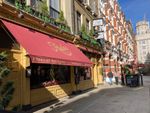
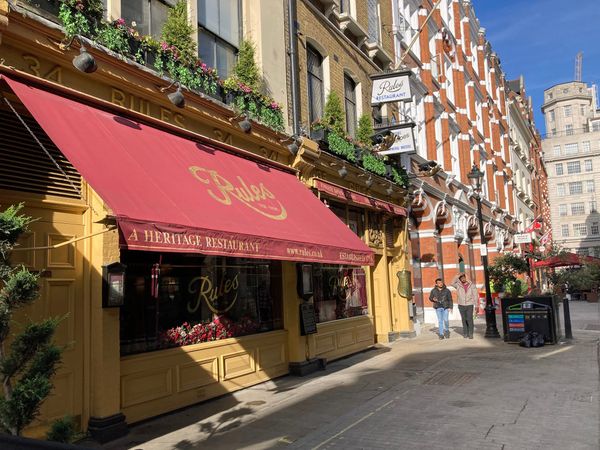
But this is not just any restaurant. It's Rules in Covent Garden, which has been serving customers since 1798 and is recognised as the oldest restaurant in London.
At first glance, it might seem an unusual addition to the National Trust's extensive portfolio. But the more I read, the more it made sense.
More than two centuries of history
Rules opened as an oyster house in Maiden Lane, Covent Garden, in 1798, founded by Thomas Rule. Since then, it has survived the Napoleonic Wars, the Blitz, redevelopment threats and more than two centuries of changing tastes.
Its list of notable customers reads like a journey through British cultural history. Charles Dickens, Charlie Chaplin, Laurence Olivier and Graham Greene were among its visitors. King Edward VII dined there, as did, more recently, David Bowie and Madonna.
Yet what makes Rules particularly remarkable isn't simply its age or its famous customers. It's that the restaurant is still operating in the same location, serving traditional British food in surroundings that retain much of their historic character.
The National Trust announced on 14 October that the building at 34–35 Maiden Lane, together with its historic collection of menus, photographs, visitor books, signs and other memorabilia, had been donated by its longtime owner, J-P Mayhew.
The gift, valued at £11 million, according to a BBC report, will bring the building and collection into the Trust's care for future generations.
Importantly, the Trust hasn't acquired the restaurant business. Ricky McMenemy, who has worked there for 35 years, still owns the restaurant independently. Rules will continue operating, paying rent to the Trust, which will use the income to support its conservation work.
In other words, the building's future is more secure, and the restaurant carries on as before.
Preserving an invisible atmosphere
One detail in the National Trust's announcement particularly caught my attention.
In 1971, when redevelopment plans threatened Rules and its surroundings, the poet and architectural campaigner John Betjeman spoke in its defence. He wasn't concerned only with the paintings, sculptures, stained glass and red velvet seating.
He also spoke of the restaurant's "invisible atmosphere".
I think that's a wonderful description of something that's difficult to define, let alone preserve.
Historic places are more than bricks, mortar, furniture and paintings. Their character comes from the people who have passed through them, the conversations they've hosted, the traditions they've maintained and the countless small experiences that accumulate over generations.
That's true of the country houses and estates we've enjoyed visiting in south-west England. But there's an important difference with Rules.
Many National Trust properties preserve the surroundings of lives that ended long ago. We walk through their rooms, admire their architecture and learn about the people who once lived and worked there.
Rules is different. It's still doing what it was established to do more than two centuries ago.
People still sit down for lunch or dinner, celebrate occasions, conduct business, and enjoy conversations in a place that has welcomed generations before them.
It's history that's still being lived.
A different kind of National Trust property
Perhaps the acquisition isn't quite as unusual as it first appears.
The National Trust already cares for 39 historic pubs, including the George Inn in south London and the Crown Bar in Belfast. Both remain working establishments. Rules will be the first historic restaurant building in the Trust's care where the restaurant continues to operate.
That distinction matters, because the Trust's role isn't only to maintain buildings as monuments to the past. It's also to protect places whose historic value is inseparable from their continued use.
Of course, owning the building doesn't guarantee the commercial success of the restaurant operating within it. The challenges of running a hospitality business remain, even when the landlord is the National Trust.
But safeguarding the building and its historic character offers a degree of continuity that's increasingly valuable in a city where so much has changed.
And there's something rather reassuring about that.
Heritage that carries on living
One of the pleasures of visiting National Trust properties is discovering how people lived in different times, in places that have survived long after their original occupants departed.
What I particularly like about the Trust's acquisition of Rules is the recognition that heritage isn't always something we look back on. Sometimes it's something we continue to participate in, often without giving its history a second thought.
I think that's what makes this such a fitting addition to the National Trust's care.
Some heritage is best protected not by putting it behind a rope, but by letting it keep doing what it has always done.
Sources:
- Landmark act of generosity secures home of London's oldest restaurant for the future (National Trust, 14 October 2026)
- Rules is delighted to announce that the building at 34–35 Maiden Lane, which has been home to our restaurant since 1798, has been gifted to the National Trust (Rules Restaurant on Facebook, 14 October 2026)
- Home of oldest restaurant given to National Trust (BBC News, 14 October 2026)
- Rules (restaurant) Wikipedia
The photo at top is by diamond geezer on Flickr, licensed under Creative Commons CC BY-NC-ND 2.0.