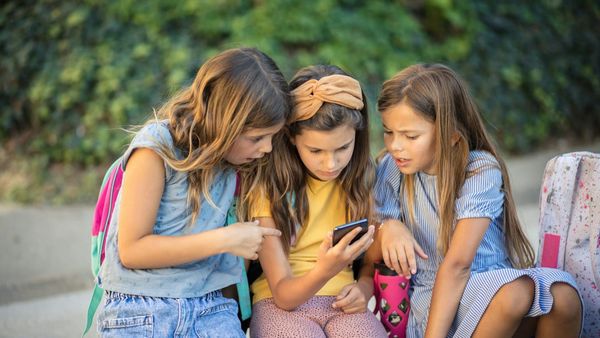
I've been watching the debate about children and social media for a long time – and not just as an observer. As a school governor, I see at closer quarters what the online world is doing to young people: the anxiety, the distraction, the social pressures that follow children home from school and into their bedrooms, mediated through a screen. And as a grandfather, I feel it more personally still.
What kind of world are we building for our children? What are we allowing to shape them, and who decided that was acceptable?
Those questions sit at the heart of my concerns about social media and young people. They've nagged at me through years of debate that has gone back and forth – about mental health, about screen time, about whether parents or platforms bear the greater responsibility, about whether legislation can ever really keep pace with technology.
But when Keir Starmer stood at a Downing Street press conference on Monday and announced that social media would be banned for under-16s in the UK, something settled for me. Not because this is a perfect policy; it's not. Not because I think it will be easy to enforce; it won't be. But because it feels, finally, like the right call.
What's actually being announced
The scope of Monday's announcement is significant. Under-16s will be prevented from accessing Snapchat, TikTok, YouTube, Instagram, Facebook and X. There are additional restrictions beyond a simple platform ban: livestreaming by under-16s will be blocked across all platforms, and strangers will be prevented from communicating directly with children – including on gaming sites. Under-18s will be barred from using AI romantic chatbot services designed to simulate sexual relationships.
The government is modelling its approach on Australia, which introduced similar measures earlier this year, but is explicitly going further. Legislation is expected to reach Parliament before Christmas, with protections coming into force in Spring 2027. The industry regulator, Ofcom, will be charged with enforcement and is being asked to conduct an urgent review of age-assurance measures.
Starmer was careful to frame this not as an anti-technology position. "I do not accept, and I will never accept, that you can't be both pro-tech and AI, and at the same time say we must protect our children." It's a distinction worth making. This isn't a lurch toward digital isolationism. It's a deliberate choice about where the line sits.
The failure of self-regulation
Here's the question I keep coming back to: did the platforms bring this on themselves? I think the honest answer is yes.
The major social media companies have had years – in some cases, the better part of two decades – to demonstrate that they could responsibly manage the environments they created for young people. The evidence that they did so is thin. Algorithmic feeds optimised for engagement, not wellbeing. Moderation systems that consistently failed to catch harmful content at scale. Age verification measures that amounted to little more than a tick-box exercise.
The commercial incentives were always pulling in the opposite direction, and the platforms largely followed those incentives. The Facebook–Cambridge Analytica scandal of the 2010s – in which the personal data of tens of millions of users was harvested without their knowledge and exploited for political targeting – remains the starkest illustration of what happens when commercial interest overrides ethical responsibility. If platforms were willing to allow that at scale with adults, it's worth asking how seriously they were ever likely to take their duties toward children.
The government's language was pointed: "Tech giants had their chance and failed." That's a blunt verdict, but I don't think it's an unfair one. Responsible stewardship of these platforms – particularly where children were concerned – would have required the companies to act against their own short-term interests. That was always going to be a big ask, and it turned out to be too big.
Taking the pushback seriously
Meta, YouTube and Snapchat all moved quickly to criticise the announcement, and their central argument deserves to be engaged with honestly rather than dismissed. The concern – that outright bans push children towards less regulated, less safe alternatives – is not frivolous. We've seen this dynamic play out before in other policy contexts.
But the most level-headed challenge I've seen since the news broke comes not from the platforms but from David Woodhouse, a software engineer, writing on LinkedIn. He cuts to the heart of it: "If social media is genuinely harmful to children, then why is the focus on banning children from using it rather than forcing platforms to change how they operate?"
It's a fair question. Woodhouse argues that the harder – and more honest – conversation is about whether the platforms themselves need fundamental reform, not just whether young users need to be banned. As he puts it: "Child safety matters. But safety built on surveillance, exclusion, and easily bypassed restrictions is not serious policy. It's a shortcut around the harder conversation of whether these platforms are operating responsibly in the first place."
He has a point. And it connects directly to the platforms' own pushback, which has a certain self-serving quality: the implicit message being that children are better off staying on our platform, where at least we have some controls in place. Maybe. But that rather glosses over the fact that those controls have historically been inadequate – and that the harder regulatory work of fixing how these platforms operate has barely begun.
Starmer reached for an analogy that I think still holds up, even in the light of Woodhouse's critique. We don't abandon the legal prohibition on selling alcohol to children simply because some teenagers find ways around it. Laws are not only enforcement mechanisms – they are expressions of social values. They shape norms, change conversations, and shift expectations over time.
The fact that a rule is imperfect, or circumventable, is not by itself a reason not to have it. But Woodhouse is right that the ban alone is not enough. The harder work – regulating algorithms, limiting harmful notifications, strengthening moderation, increasing transparency – still lies ahead.
The enforcement reality
I won't pretend the enforcement challenge is trivial, because it isn't. Verifying age at scale, across multiple platforms, without creating significant new privacy risks or excluding children who lack the right documentation, is a genuinely hard problem.
Ofcom is being handed a substantial new responsibility, and the question of whether it will have the resources, the technical capability, and the regulatory teeth to deliver is a real one.
The timeline itself – Spring 2027 – suggests the government is aware of the complexity. This will not be a quick fix, and there will be gaps and workarounds in the early stages. That's worth acknowledging honestly.
A line in the sand worth drawing
But here's where I land. Sometimes a society needs to draw a line, even when that line is hard to enforce and imperfect in its scope. It needs to say: this is where we stand, this is what we value, this is the kind of environment we want children to grow up in.
Nine in ten parents backed a minimum age of 16 in the government's consultation. Two-thirds of young people agreed that children under 16 should not be able to access at least some platforms. The public has reached a view. The government has responded to it.
The ban will not be a clean solution. There will be workarounds, edge cases, and implementation headaches. But it changes the conversation. It shifts the burden back onto the platforms, and it gives parents something concrete to point to. That matters.
I've long believed that technology companies operating at this scale carry responsibilities that go beyond their terms of service. Yesterday's announcement is, in essence, the government stepping in because those responsibilities were not being met.
And as Woodhouse rightly argues, banning young users is not a substitute for reforming the platforms themselves. But as a first step – a line drawn, a norm shifted, a burden placed back on the companies that created this mess – it's the right call.
References:
- Social media to be banned for under-16s in landmark government move to give kids their childhood back (GOV.UK press release, 15 June 2026)
- UK under-16s social media ban: which apps will be blocked and how will it work? (The Guardian, 15 June 2026)
- Social media firms hit back as Starmer announces ban for under-16s in UK (The Guardian, 15 June 2026)
- LinkedIn post on the social media ban (David Woodhouse, 15 June 2026)
- How will the UK’s social media ban for under-16s work and will it be effective? (CNN, 15 June 2026)
- Government announces social media restrictions for under 16s - Ofcom statement (Ofcom, 15 June 20260)
- Australia shows Keir Starmer may struggle to keep teens off social media (The Times, 15 June 2026)
- Facebook–Cambridge Analytica data scandal 2013-2018 (Wikipedia)
Photo at top by Getty Images for Unsplash+.