
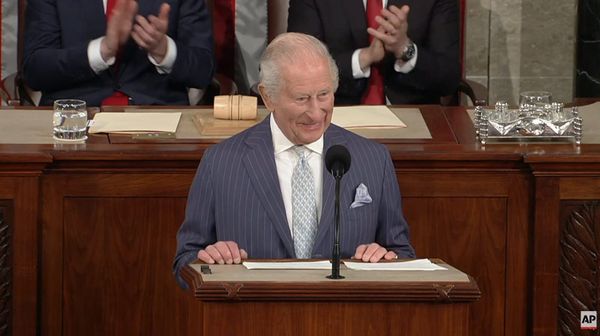
I watched King Charles's address to the joint session of Congress live on Tuesday. From the opening minutes, something felt different. The chamber was unusually still – not the restless, performative attention you sometimes see at these occasions, but something closer to genuine absorption. People were listening.
The standing ovations came early and kept coming. But it was the Magna Carta moment that stopped me. Charles's reference to the principle that executive power is subject to checks and balances brought the chamber to its feet in a way that felt less like protocol and more like relief.
Democrats, in particular, responded as though they'd been waiting for someone to say it out loud. Here was a constitutional monarch – someone who by definition cannot be political – doing political work with remarkable precision and elegance.
I found myself thinking: someone crafted this speech with extraordinary care. Many people, undoubtedly. And the question of how stayed with me long after the speech ended.
Months in the making
The Guardian published a detailed piece the following day that answered some of those questions and raised others.
The speech was months in the making. Buckingham Palace, Downing Street and the Foreign Office worked in lockstep. With a US president as unpredictable as Trump and the special relationship already under strain, a misstep in that chamber would have been very hard to recover from.
The king's private secretary, Sir Clive Alderton, was the key connecting figure: an experienced diplomat and former ambassador who knew both the palace and Whitehall inside out and liaised throughout with No 10 and the Foreign Office.
On the other side of the Atlantic, the UK ambassador, Christian Turner, and his deputy, James Roscoe, were discreetly channelling the White House view back into the process. Drafts went back and forth for months, checked and rechecked for tone, balance, and any late-emerging sensitivities. Work on the speech continued right up to the morning of delivery.
What The Guardian piece doesn't tell us – almost certainly by design – is who actually wrote the drafts. No names, no attributions.
In any other context, that omission might seem like a gap. Here it feels like the point. The whole exercise was about making the speech sound like one person, and one person only.
The king's own hand
Which brings me to the detail I keep returning to. Charles himself marked up every printed draft by hand, in red ink, writing commentary in the margins at considerable length, adding things in, crossing things out. He held meetings with Alderton on the content.
He was, by all accounts, genuinely in the room throughout the entire process – not a passive recipient of words written for him, but an active shaper of them. The jokes are his own. And there were many, which mattered: they gave the audience permission to breathe, and made the harder passages land with more force rather than less.
The result was a speech that sounded entirely like Charles. That's the hardest thing to achieve in any collaborative writing of any kind, at any level. It requires the writers to subordinate their own instincts completely to the speaker's voice and character, and the speaker to be sufficiently invested so that the words feel inhabited rather than performed.
Seeds, not headlines
The impact of the speech shouldn't be judged by what follows immediately – no doubt Trump will be back to being Trump. Something like this takes time to settle.
The more meaningful measure is slower and harder to track: how Republicans and Democrats come to view NATO, Ukraine, executive power, America's role in the world. Seeds, not headlines.
Before the visit, Politico published a sharp analysis of what the UK was actually hoping to achieve from it – and the answer was less about any single gesture than about beginning to rebuild something that has been badly strained.
The special relationship is a phrase that gets invoked far more often than it gets earned. On Tuesday, in that chamber, Charles earned it. He did everything the moment allowed him to do, and arguably a little more. What happens next is for governments, not monarchs, to determine.
The thing that was made
But the speech itself – the object, the thing that was made – is worth pausing on regardless of what follows politically.
It was the product of months of careful, collaborative, largely anonymous work, shaped throughout by the person who had to deliver it. And it achieved something genuinely difficult: it said what needed to be said, to an audience that needed to hear it, in a voice that was unmistakably and entirely his own.
References:
- The King’s Address to the Joint Meeting of Congress in Washington (British Royal Family official website, 28 April 2026)
- How King Charles’s speech was written – and how to read it (The Guardian, 29 April 2026)
- What Britain wants from King Charles’ trip to Trump land (Politico, 27 April 2026)
Screenshot at top via AP video.