
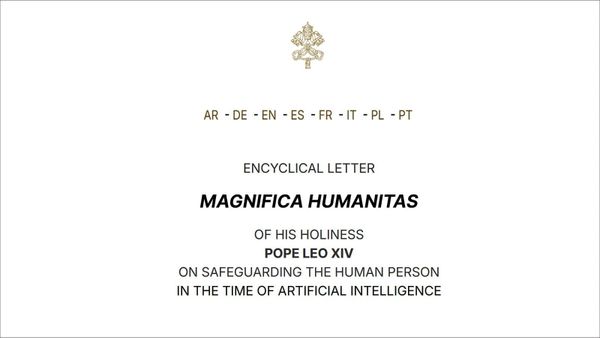
On 15 May 2026, Pope Leo XIV issued his first pastoral letter, known as an encyclical, to the whole Catholic Church. Titled Magnifica Humanitas – "Magnificent Humanity" – it runs to 47 pages and addresses one of the defining questions of our time: what does it mean to protect human dignity in an age of artificial intelligence?
It is the most comprehensive statement on AI yet produced by a major religious institution, and it deserves attention well beyond only Catholic audiences.
This past weekend, my colleague and IABC AI SIG co-lead Silvia Cambié published a powerful narrative in response. Her argument, distilled, is that communicators don't get to build AI systems – but we absolutely get to hold to account those who do. It's a clarifying thought, and I've been sitting with it since.
The question at the encyclical's heart is one I've been circling for the past year through this blog, through the FIR podcast, and through the SIG work with Silvia: what does it actually mean to stay human as AI becomes more capable, more pervasive, and more consequential? Pope Leo's answer is neither a technological rejection nor an uncritical welcome. It's something more demanding than either.
A pope who has been paying attention
This isn't Pope Leo's first word on AI. The Vatican's note Antiqua et Nova ("Old and New"), published in January 2025, drew a clear distinction between artificial and human intelligence and insisted that technology must serve people rather than the other way around. He amplified this key message in June 2025.
When Silvia, Shel and I interviewed Msgr Paul Tighe at the Vatican last July for an FIR podcast, he spoke about what he called "the wisdom of the heart" – the recognition that each person is a unique being of infinite value, and that the future must be shaped with and for people. Magnifica Humanitas builds directly on that foundation, but with considerably more force and scope.
Two biblical images, one urgent choice
The encyclical frames its argument through two contrasting stories. The Tower of Babel – collective effort driven by pride, uniformity and self-sufficiency, ending in fragmentation. And Nehemiah's rebuilding of Jerusalem – shared responsibility, attention to the most vulnerable, patient work, brick by brick.
These aren't decorative metaphors. They're the diagnostic lens Leo XIV applies to every institution, every developer, every policymaker. (Which kind of construction are you participating in?)
What the encyclical actually says
The document covers a lot of ground. On the nature of AI itself, the Pope is direct: these systems imitate certain functions of human cognition, but they possess no moral conscience, no lived experience, no capacity for genuine relationship.
That's not a limitation that more computing power will eventually overcome – it's a categorical difference that must inform how AI is governed and where its use is appropriate.
On power, he is equally direct. When control over platforms, data and algorithms sits in the hands of a small number of private actors, accountability becomes opaque and the common good becomes subordinate to profit. He calls for AI to be "disarmed" – freed from the logic of geopolitical and commercial competition – and genuinely opened to democratic participation.
On work, the Pope treats the displacement of employment as a justice issue, not a neutral economic adjustment. On truth, he calls for an ecology of communication grounded in transparency and genuine digital literacy. On freedom, he identifies both addictive platform design and algorithmic social control as serious moral concerns.
And in a passage that sets this encyclical apart from most AI ethics discourse, he connects unchecked technological power directly to the normalisation of war – arguing that the traditional "just war" framework is now inadequate, and that lethal decisions cannot be delegated to autonomous systems.
Underlying all of it is a consistent anthropological claim that I find persuasive: human vulnerability and limitedness are not defects to be engineered away. They are the conditions in which compassion, wisdom and authentic relationship develop. The transhumanist vision that animates much of Silicon Valley's self-understanding is addressed directly and rejected – not as anti-scientific, but as spiritually impoverished.
Why this matters beyond religious audiences
I am not a Catholic. But I've found this document genuinely useful – not as a policy framework to be applied, but as a serious articulation of what is actually at stake. Its core argument is one I keep returning to in different forms: AI is not morally neutral. Justice must shape the design of these systems from the outset, not be applied as an afterthought. And human dignity is the non-negotiable standard against which all of it must be evaluated.
Silvia puts it well in her piece: communicators don't build these systems, but we are accountable for the questions we ask and the silences we choose. That feels right to me. If intelligence becomes abundant, alignment becomes the scarce resource – and alignment, in the deepest sense, is a human responsibility that no algorithm can discharge on our behalf.
Magnifica Humanitas makes the case for taking that responsibility seriously. It's worth the 47 pages.
Sources:
- First Encyclical Letter of His Holiness Leo XIV Magnifica Humanitas (The Holy See, 25 May 2026)
- Comms Lessons from Nehemiah in the AI Age (Silvia Cambié, 29 May 2026)
- FIR Interview: Monsignor Paul Tighe on AI, Ethics, and the Role of Humanity (For Immediate Release, 29 July 2025)
- Antiqua et Nova - Note on the Relationship Between Artificial Intelligence and Human Intelligence (The Vatican, 14 January 2025)
Additional References:
- Reputation in the age of AI: it's about people, not technology (Studio6, 20 April 2026)
- The other side of human-centred AI (Studio6, 9 March 2026)
- Reflections from 2025: AI is Not One Thing – It Is a Set of Choices (Studio6, 22 December 2025)
- What Does It Mean to Stay Human in the Age of AI? (Studio6, 26 August 2025)
- Speaking for Humanity: The Wisdom of the Heart in the Age of AI (Studio6, 30 July 2025)
- Pope Leo Takes on AI: Communicators Should Pay Attention (Studio6, 19 June 2025)