
In May 1997, I voted Labour for the first time. I was not alone – millions of people who had never voted Labour, or hadn't for a long time, did the same. Tony Blair had done something that seemed almost impossible: he had made Labour electable again, and had done it not by triangulating toward the middle but by genuinely rethinking what a centre-left party was for.
New Labour felt like a project with a purpose. That matters because what followed was consequential: three election wins, the minimum wage, the Good Friday Agreement, devolution, and the largest sustained investment in schools and the NHS that either institution had seen in a generation.
And then Iraq.
It is impossible to write about Tony Blair without naming it. The decision to join the US-led invasion in 2003 – based on intelligence that proved false, pursued without UN authorisation, and followed by an occupation that descended into catastrophe – shattered the moral authority that had made New Labour possible.
It cost Blair his premiership, his reputation, and, in the eyes of many, his right to be heard at all. That shadow does not lift. He knows it. Anyone reading him now knows it too.
But here is the question worth sitting with: can a tainted messenger still carry a true message?
A project with a purpose – or a warning without one?
Blair published a substantial essay this week – "The Labour Party is playing with fire over its future and the future of the country" – through his Institute for Global Change. It is long, serious, and in places uncomfortably direct. It is also, whatever you think of the man, hard to dismiss.
His central argument is that Labour is making a category error. The debate inside the party – about Keir Starmer's leadership, about whether to move left or back toward Europe – is treating political positioning as a substitute for policy thinking.
Blair's contention is that the country faces two genuinely epochal changes: a new geopolitical order in which the US, China, and eventually India form a dominant G2/3, leaving every other nation as a middle power; and an AI-driven technological revolution that will reshape economies, public services, and the nature of work itself. Britain, he argues, is unprepared for either.
On the geopolitical point, he is blunt about Britain's diminished standing – the cooler relationship with Washington, Brexit's self-exclusion from European decision-making, and the loss of the Department for International Development (DfID), Blair's own creation in 1997, whose abolition under Boris Johnson in 2020 stripped away a significant layer of British soft power in the developing world.
On Europe (specifically, the European Union), he is careful. He wants a "structured relationship" eventually, but insists it can only be negotiated from a position of economic strength – not from sentiment, and not as a reversal of Brexit for its own sake.
On AI, I find him worth hearing out – and not only because it is a subject I follow closely. His argument that governing in the age of AI will be the defining challenge for any government in the foreseeable future is compelling. His ten-point domestic agenda – which includes making AI adoption central to government reform, planning deregulation, cheaper energy over net-zero acceleration, and wholesale welfare reform – is not a comfort-zone policy list. Some of it will make Labour members wince. Some of it should.
He calls this position the "Radical Centre" – a place where policy leads, and politics follows, where the right analysis comes first, and the political strategy is built around it. He credibly argues that this space is currently vacant in British politics.
Touching a wound
The essay landed like a grenade. Blair praised both Andy Burnham and Wes Streeting by name – two of the most prominent figures circling the Labour leadership. Both hit back almost immediately.
Streeting argued that the essay's glaring weakness is its near-total silence on inequality, which he called "the defining issue of our age" and the actual cause of the political crises reshaping Western democracies. Burnham promised a detailed rebuttal.
The speed and sharpness of those responses tell you something – not that Blair is wrong, but that he has touched a wound. These are not the reactions of people who found the essay easy to ignore.
Which brings me back to where I started. Does Blair's voice still matter?
I think it does – precisely because he has nothing left to protect. The politicians who might say these things tend not to, because the internal party cost is too high. Blair has already paid every cost there is. That frees him to say what many in the Labour mainstream are thinking but won't articulate.
The frustration is that his Iraq legacy gives those who want to dismiss the argument an easy way to dismiss the messenger instead.
That is their loss, and potentially the country's.
The essay is worth reading in full. Not because Blair is right about everything, and not because his past record earns him uncritical deference. But because the argument stands on its own, and very few people in British politics are making it.
In 1997, I voted for the possibility he represented. That possibility – a politics that takes ideas seriously, governs from evidence, and is genuinely radical about the right things – still exists.
Whether Labour chooses it is another matter entirely.
Sources:
- The Labour Party Is Playing With Fire Over Its Future and the Future of the Country (Tony Blair, 26 May 2026)
- Burnham and Streeting accuse Blair of ignoring inequality as they hit back at ex-PM (BBC News, 27 May 2026)
- Tony Blair is right about Labour — but it is worse than he says (The Times, 27 May 2026)
- 2026 Labour Party leadership crisis (Wikipedia)
- Tony Blair (Wikipedia)
- New Labour (Wikipedia)
- 2003 invasion of Iraq (Wikipedia)
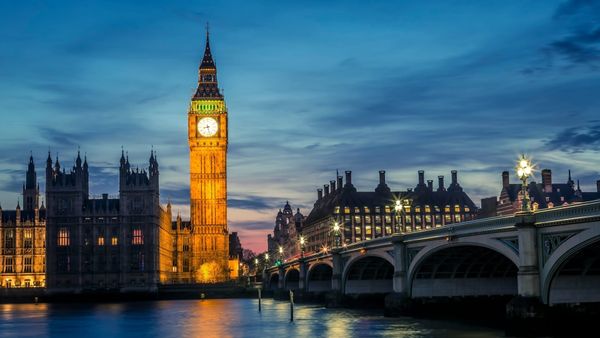
Photo at top by Getty Images for Unsplash+.