
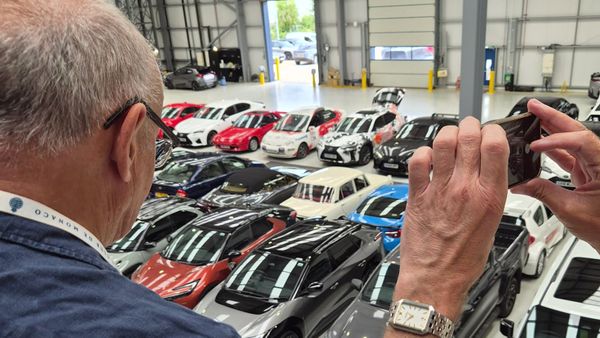
I spent last Thursday at the Toyota Media Experience Centre just outside Gatwick airport – a vast hangar of a building that also houses the Toyota Heritage Collection of around twenty-eight classic and rare vehicles spanning the full arc of Toyota's UK history over the past sixty years.
The collection ranges from a 1965 Corona, the first model Toyota ever imported here, through to the latest Land Cruiser, an enormous thing that somehow holds its own alongside its ancestors. I drive a 2020 Corolla, so I lingered long by the two 1986 models they had on the floor.
There's something quietly clarifying about seeing where a car you know well came from. I took photos from the balcony overlooking the collection, then more from down amongst the cars themselves. It was a good place to spend some time after talking about the future.
Which I had done, as I was there to speak to the members of the Guild of Motoring Writers at their AGM. The broad subject was AI and journalism. What followed – for about forty minutes in total, running longer than planned because the questions kept coming – felt like one of those conversations where you can tell something has genuinely landed.
What I set out to say
My presentation had two parts. The first covered what AI is already enabling people in automotive journalism and wider media to do: research, drafting, transcription, image generation for social assets, and SEO-optimised content distribution. None of this is hypothetical – it's happening now, under real economic pressure, in newsrooms and media businesses across the industry.
To illustrate the risks of that, I opened with a story that landed exactly as I'd hoped. In May 2024, a website published a piece about the worst cars people had ever owned – sourced from a Reddit thread, processed by AI, published on Yahoo Finance. One entry was headlined: "2023 BMW BRZ."
The BRZ is actually a Subaru. It has never been made by BMW. The AI had scraped the thread, seen "BMW" mentioned elsewhere in the discussion, and combined it with a username that contained "BRZ" – producing a car that does not exist, with complete confidence. The Autopian's headline on the story called it "EMBARRAISSING", in enormous letters, which seemed about right.
That's the obvious failure. But I was more interested in the subtle one. I showed the room a paragraph of automotive review prose – composed, assured, and hitting all the right notes on ride quality, steering weight, and refinement. I asked whether it seemed decent. Most nodded. I told them it had been written by AI in about four seconds. No test drive. No press fleet. No early morning on a wet B-road. No conversation with the engineers. Just a prompt and a plausible-sounding paragraph.
Plausibility is not accuracy. Speed is not expertise. In motoring journalism – where a fabricated torque figure or an incorrect safety rating actually matters to readers, to manufacturers, and to professional reputations – that distinction is everything.
I also talked about the EY case, which I'd written about on my blog in May. EY withdrew a cybersecurity study after it emerged that citations had been fabricated, footnotes pointed nowhere, and a McKinsey report cited in support simply didn't exist. Similar failures at Deloitte and Sullivan & Cromwell had preceded it. Each time, the tools got the blame. Each time, the humans issued a statement about their commitment to accuracy.
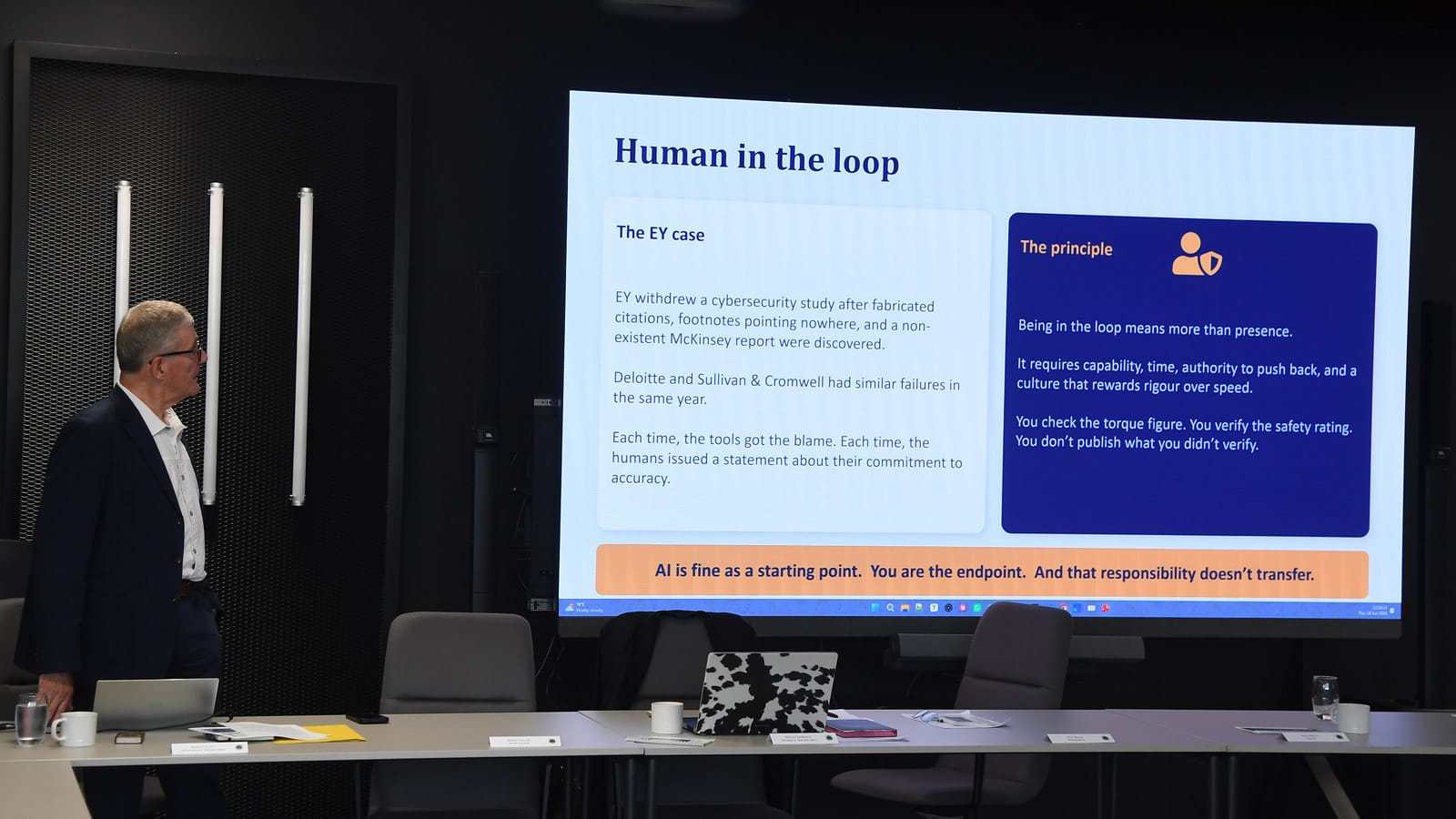
"Human in the loop" has become almost meaningless through overuse. Being in the loop means more than presence. It requires capability, time, authority to push back, and a culture that rewards rigour over speed. The responsibility doesn't transfer to the tool.
The second part of the presentation was the one I find more interesting – and the one that seemed to resonate most in the room.
AI has never sat in a car. It has never felt the difference between a chassis that inspires confidence and one that quietly unnerves you – that faint sense that the car isn't quite in control of itself. It has never noticed that the seat bolster catches your left hip, or that the infotainment system requires your eyes for just a fraction too long. These are embodied, sensory judgements. They belong to the person who was there.
I mentioned two journalists whose work appears regularly in the Telegraph motoring section – Alex Robbins and Andrew English. Two very different voices, two different approaches. But in both cases, the personality comes through. Readers follow writers, not outlets. They come back because they trust a specific perspective, built over time through consistency, honesty, and the occasional unpopular verdict. AI can produce a voice. It cannot build a reputation.
The Reuters Institute's 2025 report on generative AI and news found that only 12% of people are comfortable with fully AI-generated news content, compared to 62% for entirely human-made content. That's not a rounding error. It's a signal. When people want to verify suspect information, they turn first to a trusted news source – AI chatbots came last, at just 9%. Trust still flows to named journalists, not algorithms.
What they actually asked
I'd asked the group two questions of my own during the Q&A – who's using AI, and what for? The hands went up. The answers ranged from research and transcription to drafting and social media. No sceptics. No one dismissing the whole notion. That was encouraging.
But the questions they came back with were revealing.
One came from someone who'd had a difficult experience at university – work penalised because an institution claimed it detected AI involvement, despite his denial. We had a fairly robust discussion about this. My position was: if someone accuses you of using AI, ask them what specifically they're claiming. Are they saying you tried to deceive? That the work isn't authentically yours? What's the evidence? "It has em dashes in it" is not a standard of proof. These accusations tend to collapse under a direct question.
More practically, I suggested that if you're confident in how you're using AI – for research, for reviewing drafts, for suggesting angles, for doing the things a knowledgeable colleague might do – then say so. Sidestep the defensiveness. Here's what I used it for. Here's what it gave me. Here's what I did with that.
There were questions about plagiarism, about deepfakes, about organisational policy. And there was one that I think is genuinely the hardest: what do you do when your boss refuses to let you use AI and will penalise you if you do?
I'd say be transparent about what you're using AI for, and make the value visible (although the fuller answer is much more complex). I acknowledged that this is not a comfortable situation to be in. Some leaders aren't ready for this yet. Some won't be for a while.
We're in a phase – and it is a phase – where the gap between what's possible and what's permitted varies wildly depending on who you report to. That will change. It usually does.
A word about curiosity
After the presentation and a tour of Toyota's heritage collection, I spoke to a key member of Toyota's PR department, clearly someone with the right approach to all of this: curious, practical, wanting to understand what AI can do so she can do her job better. Toyota uses AI in a setup that gives her confidence in what she's working with.
What struck me about the way she described it was the word curious. That's where this starts. Not with a mandate, not with a policy document, not with a leadership decree – but with someone who wants to figure out what's possible, and who has the organisational space and support to do so. People like this are the ones who move this forward in organisations. If the conditions are right, they become the catalyst for everyone watching.
The question I keep coming back to
People keep asking whether AI will replace journalists. I think that's the wrong question.
The better question is: what kind of journalism do we want to exist? And are we – as writers, as publishers, as communication professionals – making choices that support that?
AI will write more and more content that looks like journalism. That's already happening. What it cannot do is replace the journalist who was there, who knows, who cares, and who puts their name to it.
The room I spoke to last week is full of people who do exactly that. In a world increasingly full of AI-generated content, that matters more than it might seem.
With thanks to Richard Aucock, Vice Chair of the Guild of Motoring Writers, for the invitation to address the AGM on such a timely topic, and to everyone at Toyota for their hospitality. Thanks also to all who attended and engaged so thoughtfully on the day.
References:
- Guild of Motoring Writers
- Toyota Media Experience Centre
- Toyota Heritage Collection
- The human in the loop – or not (Studio6, 18 May 2026)
- Generative AI and news report 2025: How people think about AI’s role in journalism and society (Reuters Institute for the Study of Journalism, 7 October 2025)
- This Seemingly AI-Generated Car Article On Yahoo Is A Good Reminder That AI Is An Idiot (The Autopian, 3 May 2024)