
Last weekend, I shared some good news on LinkedIn and Facebook. After months of illness, tests and treatment, I'd received confirmation from Yeovil Hospital that the infection in my chest and lungs had cleared.
It was the news I'd been hoping for since July, when what initially seemed like heat exhaustion developed into a much longer and more debilitating illness. In September, I'd written about the experience in When illness puts everything on hold.
This time, the story was a happier one. I included a photograph my wife Laura had taken of me that day, looking considerably healthier than I had in recent months.
I wanted to share the news with friends, colleagues and others in my networks. I wasn't thinking about reach, engagement or any of the other measures that occupy so much attention in social media communication.
Reactions began arriving, followed by comments from people I'd worked with, known, or encountered over the years. Some I hadn't heard from in a very long time. Others I hadn't realised were following me at all.
The warmth of the responses was remarkable. So was the number of people who took the time to write something personal.
And then I looked at the analytics.
The numbers tell part of the story
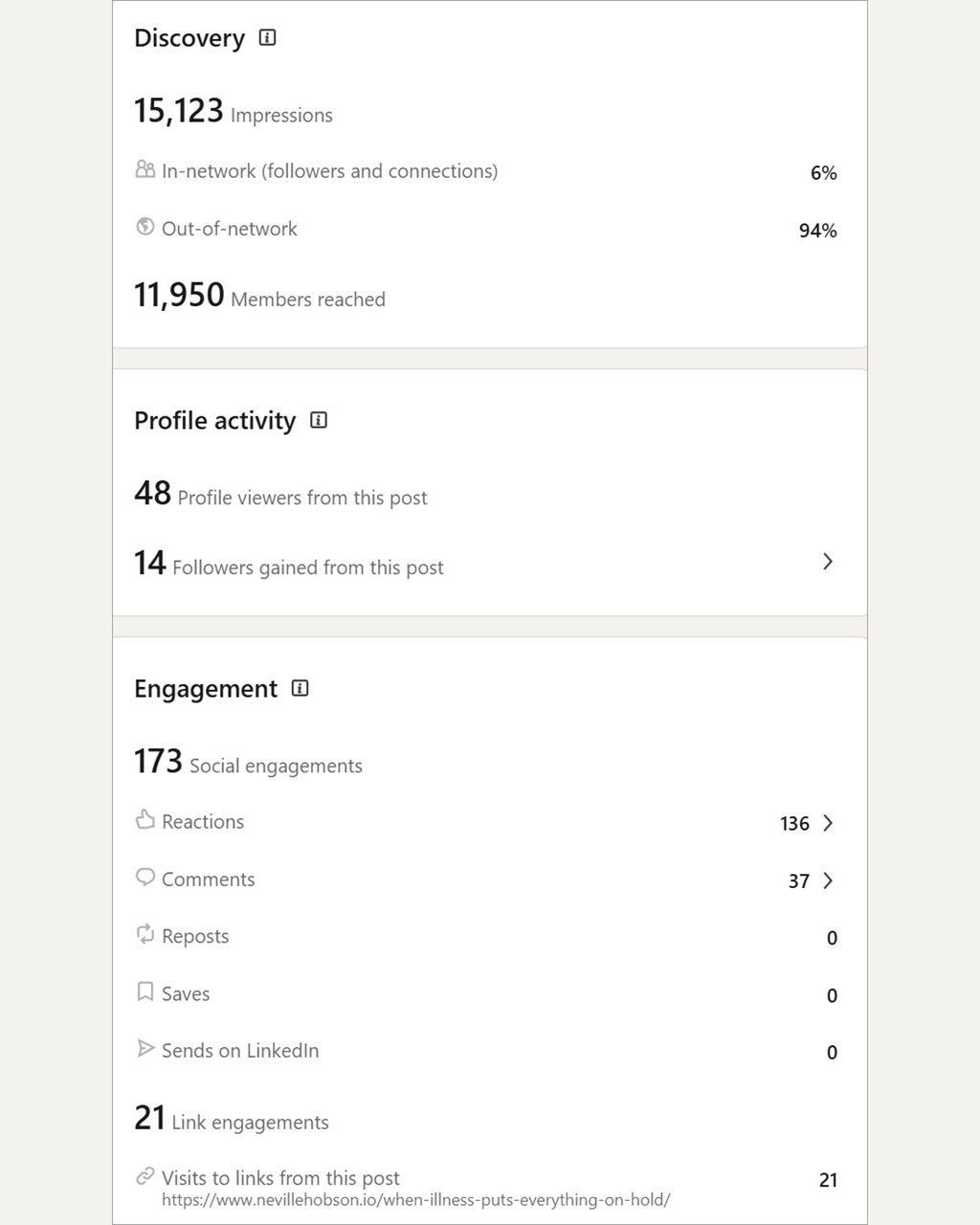
By 21 November, the LinkedIn post had attracted 136 reactions and 37 comments. For someone whose typical posts generate far less attention, these numbers were striking.
But the reach figures were really surprising. The post had generated 15,123 impressions, reaching an estimated 11,950 members.
What really caught my attention, though, was the discovery that 94% of those impressions came from outside my network. Most of the time, the post appeared on someone's screen outside my existing connections and followers.
That was extraordinary, and not something I'd anticipated when sharing a personal update.
The post also prompted 48 visits to my profile and brought 14 new followers, according to LinkedIn's analytics. Some commenters were familiar names from earlier chapters of my professional life. Others were new connections.
I can't know precisely why the post travelled so widely. The subject, photograph, comments and LinkedIn's distribution systems may all have played a part. It's tempting to credit the algorithm, but that would be speculation.
What I do know is that the post reached considerably further than I expected, prompting thoughtful comments and personal exchanges that went far beyond clicking a reaction button.
And then there was a historic restaurant in Covent Garden
This wasn't the first time recently that something I'd written had attracted an unexpectedly large audience.
In October, I published a post about the National Trust acquiring the building that houses Rules, London's oldest restaurant established in 1798.
It appealed to my interest in British heritage, especially since moving to Somerset and becoming a regular visitor to National Trust properties.
What caught my attention was the unusual nature of the acquisition. The Trust wasn't taking over the restaurant business. It was safeguarding the historic building and its collections while allowing the restaurant to continue operating independently.
In my article about the National Trust's acquisition, I reflected on the idea of living heritage – places whose value comes not simply from preserving their past, but from continuing to be part of everyday life.
The LinkedIn post about the article attracted 49,145 impressions, reaching almost 38,000 members, with 291 reactions and 37 comments. But I hadn't appreciated until I looked more closely at the analytics that an astonishing 99% of those impressions came from outside my network.
That's an even greater discovery beyond my existing audience than the 94% recorded for my health update.
Two very different subjects, both travelling far beyond the people in my network or who already follow me. And neither was written with that objective in mind.
At first glance, the two subjects could hardly be more different. One concerned a very personal experience of illness and recovery. The other was about an organisation dedicated to heritage and conservation, and a historic London restaurant.
Yet both prompted responses far beyond what I usually see when writing about AI, organisational communication, leadership and related professional subjects.
That contrast has made me curious.
What makes a story resonate?
I don't think there's a single explanation.
My health update concerned an experience that many people understand, whether from their own lives or those of family and friends. Illness, uncertainty, recovery, and the relief of receiving good news aren't confined to any profession, industry, or particular generation.
And perhaps there's something reassuring about someone sharing a positive outcome after a difficult period.
The National Trust/Rules story appealed to something different. History, familiar places, continuity, nostalgia, perhaps even the pleasure of discovering something unexpected about a well-known institution.
Both subjects were accessible to people who might have little interest in my usual writing about communication and technology.
Many of the comments on the health update post weren't simply congratulations. They were messages of friendship, expressions of relief and recollections of connections made over the years.
I found myself replying to people whose names brought back memories of working together, attending conferences, discussing new technologies or simply being part of overlapping professional communities.
The online interaction reopened conversations that had been dormant for years. That was something I hadn't anticipated when I published the update.
Authenticity isn't an engagement strategy
There's an obvious temptation to look at these numbers and conclude that personal posts are the way to attract attention on LinkedIn. I think that would be entirely the wrong lesson.
Similarly, I wrote about the National Trust's acquisition of a building housing a historic restaurant because I found the story interesting and thought others might too.
Neither post was intended to increase reach or attract followers. That distinction matters.
There's nothing inherently wrong with thinking about audiences, making content accessible or using analytics to understand what people respond to. Those are legitimate parts of communication. But turning personal disclosure into a technique for generating engagement would feel uncomfortable to me.
Not everyone wants to share their health, family circumstances or other private experiences publicly, or read about others doing that. Nor should they feel pressured to do so because personal stories might attract more attention.
And writing about specialist subjects remains valuable, even when the audience is smaller.
A thoughtful exchange about AI governance with a handful of people who understand and care about the issue can be more consequential than thousands of impressions on a widely appealing story.
Different forms of communication serve different purposes. The challenge is recognising the difference.
Are we measuring what matters?
This experience also brings me back to a question I've encountered repeatedly throughout my professional life in communication: are we measuring what matters, or simply what the available tools make easy to count?
Social platforms give us an abundance of numbers. Impressions, reach, reactions, comments, shares, followers, profile visits and more.
Some of these measures are useful. They help us understand distribution, identify trends and compare how different content performs. But they're indicators, not explanations.
LinkedIn can tell me that my post generated 15,123 impressions. It can estimate how many people saw it and how many were outside my existing network. But it cannot tell me what it meant to hear from someone I hadn't spoken to in 15 years.
Even the comments figure has limitations. Thirty-seven comments might represent brief acknowledgements, detailed conversations, disagreements or something much more personal.
The number alone doesn't distinguish between them.
The value of invisible engagement
There's another dimension to this that I hadn't considered quite so clearly until I read a LinkedIn post by Janice Thorne.
Janice wrote about people sometimes described as LinkedIn "lurkers" – those who read posts but rarely comment, react or publish anything themselves.
She described meeting a colleague who mentioned one of her earlier posts. It had prompted an hour-long conversation between the colleague and her daughter about the daughter's future. Yet the colleague had never reacted to the post or commented on it.
As far as LinkedIn's analytics were concerned, that meaningful exchange was invisible. Janice drew several conclusions, but one particularly struck me:
"Engagement numbers show you what was visible. They don't show you what was valuable."
That neatly captures something I've believed for years: impressions alone tell us very little about how effective communication is. What really matters is what people do with the content they encounter.
But Janice's example adds an important qualification to my thinking. What people do isn't always something we can observe, let alone measure.
A post might prompt a private conversation, encourage someone to reconsider a decision or simply give them something worth thinking about. None of those outcomes necessarily produces a like, comment or share.
Of course, silence doesn't prove that something meaningful happened, any more than an impression proves someone read a post. But neither does silence mean indifference.
It's a useful reminder that the value of communication can extend well beyond what the platform records.
Purpose before measurement
This isn't an argument against analytics. Quite the opposite. Good measurement is essential to understanding whether communication is achieving its purpose.
But the purpose needs to come first. If my objective had been to reach a large audience, impressions would have been a relevant measure.
If it had been to encourage a discussion, comments and the nature of those exchanges would have told me more.
In this case, my original purpose was simply to share welcome news. I hadn't defined an engagement objective, let alone a target number of impressions.
The response gave me something I hadn't been measuring and hadn't expected. That doesn't make it impossible to evaluate. It simply means the headline figures didn't capture the most meaningful outcome.
And, as Janice's example demonstrates, some meaningful outcomes may never become visible to the person who published the content.
More than an impression
I've spent a great deal of time over the years exploring how digital technologies change the way we communicate.
Social media has made it remarkably easy to publish a thought, share an experience and reach people far beyond our immediate circles. Algorithms influence who encounters what we publish. Analytics provide detailed accounts of what happens afterwards, at least in quantitative terms.
Sometimes those responses create new connections. Sometimes they renew old ones. And sometimes they remind us that relationships established years ago haven't entirely disappeared, even when everyday contact has.
I don't want to overinterpret two unusually successful posts. They don't prove that personal stories outperform professional content, or that certain subjects are guaranteed to generate attention.
They've simply reminded me that reach and resonance aren't the same thing. The numbers told me how far my words had travelled. The comments reminded me why I'd wanted to share them in the first place.
And of the two, I know which will stay with me longer.
References:
- "Friday the 13th – a day of good news!" – posts on LinkedIn and Facebook, 13 November 2026
- When illness puts everything on hold – Studio6, 27 September 2026
- The National Trust's newest property is home to London's oldest restaurant – Studio6, 18 October 2026
- Janice Thorne's LinkedIn post on quiet readers and engagement – LinkedIn, 18 November 2026
- LinkedIn Help – Post analytics
The LinkedIn figures are snapshots recorded on 21 November 2026 and may have changed since.
Hero image: Adobe Express Premium. LinkedIn screenshot by author.