


I've been judging professional awards contests for more than 15 years – digital PR, social media, content, search, and more. In that time I've read hundreds of entries. Some have been outstanding. Many have been good. And a significant number have been frustrating to score – not because the underlying work was poor, but because the entry itself let the work down.
That gap between the work and how it is presented is the central problem I see, contest after contest, year after year. Talented teams doing genuinely impressive work submit entries that fail to communicate what they actually achieved. They lose marks not on substance but on execution – on measurement that is vague, visuals that are missing, or narratives that read like brochures rather than stories.
This post is a practical guide to closing that gap. It draws on my scoring notes from contests I've judged this year, and the patterns I've observed over a long career as a judge. The advice applies to any professional award contest, not just the ones I mention here – the principles are consistent across disciplines and sectors.
I'm a long-standing judge for Don't Panic Events, a specialist awards organiser I've worked with since their founding in 2005. This year I've been judging five of their contests: the UK Content Awards 2026, Global Social Media Awards 2026, European Search Awards 2026, UK Digital Excellence Awards 2026, and Global Agency Awards 2026.
Last week, I joined fellow Don't Panic judges David Edmundson-Bird, Dawn Anderson, and Jim Banks for The Definitive Guide to Entering the Search Awards, a webinar which attracted more than 60 registrants and generated some lively discussion.
It's partly that webinar that's prompted this post, although it's been a topic on my write-about-this list for some time. What follows is the detail behind four of the most significant areas in an award entry that can spell the difference between success and failure.
The gap between good and excellent
One phrase appears repeatedly in my judging notes:
"Overall, a good entry that could have been excellent."
That gap is rarely about the quality of the work being entered. It is almost always about how that work is presented, evidenced, and explained. The areas I cover below – measurement, visual storytelling, and narrative quality – are all within your control before you submit.
1. Objectives, measurement, and budget
This is the single most impactful category across every contest I judge. Entries that fail here are penalised regardless of how impressive their results appear – because without stated, measurable objectives, results cannot be evaluated against a plan. The pattern is almost always the same: strong outputs reported at the end, but no yardstick set at the beginning.
The corollary is equally important: when entrants do set clear, quantifiable objectives, and include budget breakdown or financial band, the Results section almost always reads as compelling and credible – and judges can see precisely where targets were met or exceeded.
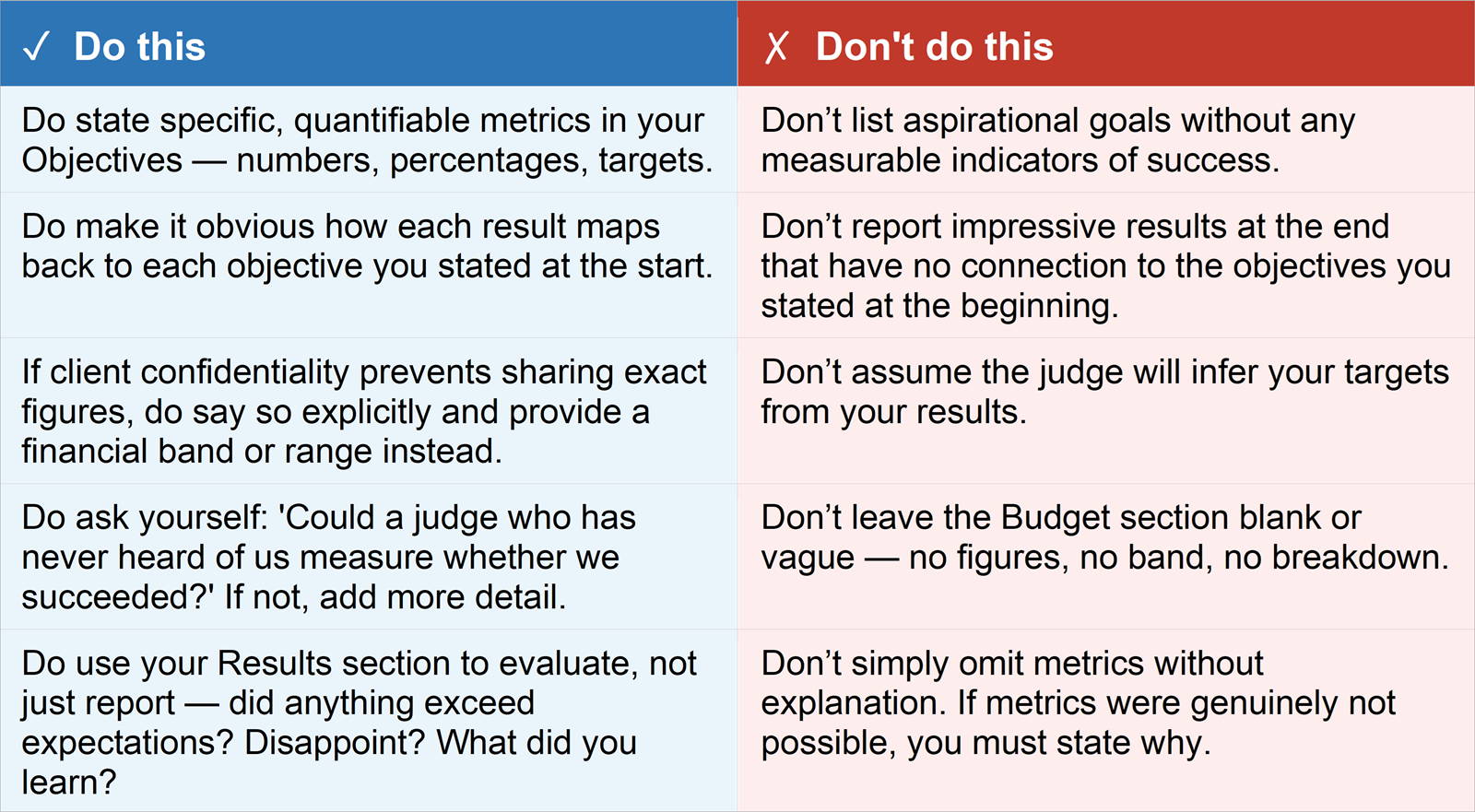
Here is what a strong entry in this area looks like, from my judging notes:
"Highly impressive results where you exceeded all the objectives you set out at the start. An illustration of how effective – and important – quantifiable metrics are in judging success."
And here is the flip side:
"You reported impressive results, but the objectives you set out earlier didn't include any quantifiable metrics, making it difficult to gauge the effectiveness of your activities. Did they all align with your expectations? Did any excel? Did any disappoint?"
2. Visual storytelling within entries
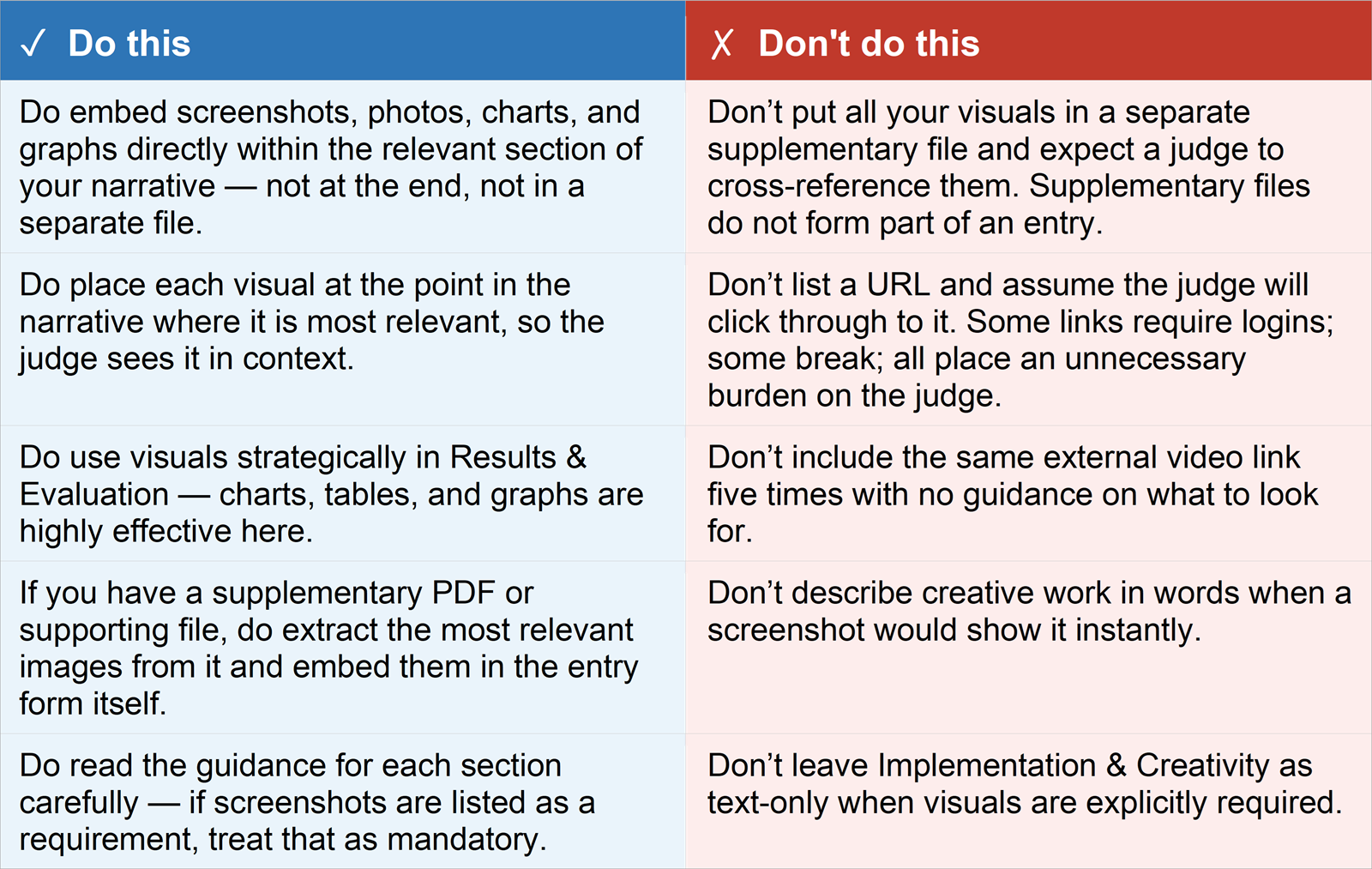
This is the most operationally fixable issue in award entries – and yet it appears with remarkable consistency. The guidance for Implementation & Creativity explicitly requires screenshots to be embedded within the narrative. Many entrants either ignore this, place visuals in supplementary files (which do not form part of an entry), or list URLs and expect the judge to go and look.
The difference between a narrative supported by embedded visuals and one that is not is stark at the moment of judging. Entries that get this right are notably easier and more enjoyable to score.
From my judging notes:
"Good use of screenshots within the Implementation & Creativity narrative and elsewhere that helped visualise your story: helpful for judging."
And when it goes wrong:
"Including required screenshots directly within the narrative in Implementation & Creativity, connecting each story element, would have been helpful to visualise your story at the moment of judging. This was a requirement stated in the guidance for this section."
3. Narrative quality and storytelling
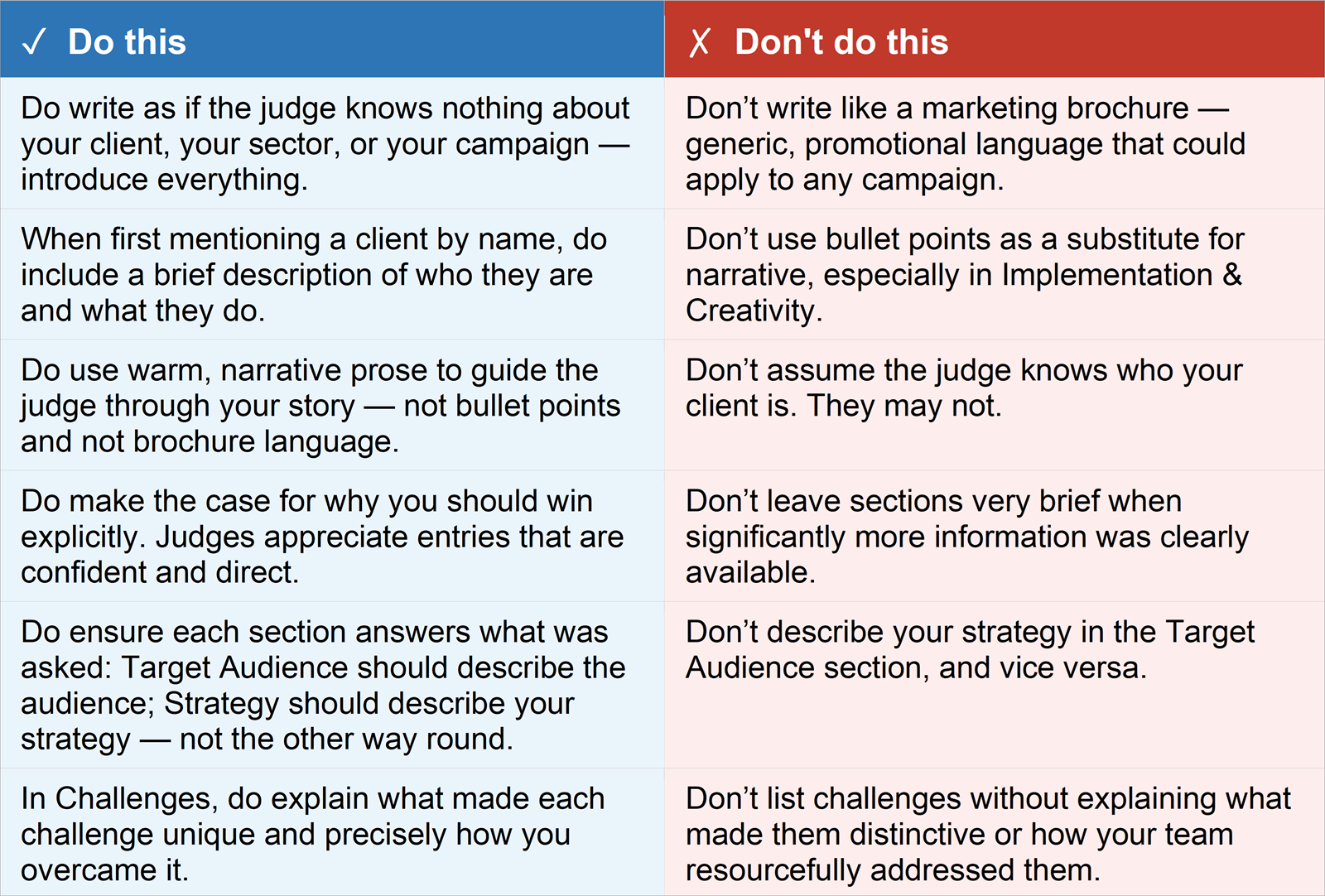
This is what separates good entries from excellent ones. An award entry is not a brochure, a white paper, or a bullet-pointed status report. It is a story – and it should be written as one. Judges respond to entries that guide them through a journey: here was our challenge, here is what we did, here is what happened, here is what it meant.
Two related issues appear repeatedly: entries that assume the judge has expert knowledge of the client or industry, and entries where individual sections are so brief that they fail to convey the full picture. If you have more to say – and you almost certainly do – say it.
From my judging notes, an example of where this went wrong:
"Implementation & Creativity was a great opportunity to tell a compelling story. It lends itself to a warm narrative, but you offered only brief bullet points that exposed little about fresh and innovative thinking, best practices or your resourcefulness."
And an example of where it went right:
"A very good storytelling narrative in Implementation & Creativity, where you made good use of supporting visuals strategically placed within the narrative. Standouts: high-performance content pillars and creative testing – compelling storytelling. You made a very good case for why you should win this category!"
4. Additional watch-outs
A handful of issues appear less frequently but are significant when they occur – often because they suggest an entry was prepared without reading the guidance carefully.
AVE – a metric to avoid
Advertising Value Equivalency (AVE) is a controversial measurement metric that has been formally disowned by the CIPR, PRSA, AMEC, and other professional bodies. Often referred to as a "vanity metric," the CIPR has banned its use in entries to their own award programmes. Using AVE in an entry to any professional awards contest signals a lack of awareness of current industry standards and undermines the credibility of your measurement approach. Do not use it.
Using the entry form
The entry form exists for a reason: it ensures every entry is presented on equal terms, making the judge's job easier and your entry fairer to assess. Submitting a bespoke Word document, or copying and pasting unformatted text into a lengthy document, creates unnecessary frustration during the judging process and disadvantages the entry. One entry I judged in a recent contest where the entrant had created their own entry form with unformatted text was described in my notes as "extremely difficult to read and interpret." Use the form provided.
Supplementary files
Separate supporting files – PDFs, additional documents, video files – do not form part of an entry. They will not be judged as such. Any material you wish to be assessed must appear within the entry form itself, embedded where relevant.
External links and access
If you include links to external material in your entry form, ensure they are accessible at the moment of judging without a login. Locked documents, broken links, or links requiring account creation cannot be accessed and will be ignored. If a link leads to a document or video, include a brief explanation in the narrative of what it shows and why it is relevant. Don't just provide a list of links.
A word on using AI to prepare your entry
The question of AI use is one that hovers over award contests – specifically, whether entrants should be allowed to use it when preparing their submissions. Some feel it should be banned outright. I disagree, and here is why.
Generative AI is now a standard tool in professional life. Treating it as somehow illegitimate in the context of award entries misunderstands both how people work today and what judges are actually assessing.
Here are three practical reasons why AI has a legitimate role in preparing a stronger entry:
- It helps you articulate and structure your thinking. Many entrants know their campaign inside out but struggle to present it clearly on the page. AI can help organise your narrative, sharpen your language, and ensure your entry flows logically from objectives through to results. The thinking still has to be yours – AI simply helps you express it more effectively.
- It cannot fabricate the substance of a winning entry. AI can help you write. It cannot invent genuine results, real strategy, or authentic impact. The work still has to have happened. Judges evaluate what you achieved and how well you demonstrate it – AI cannot manufacture that evidence, only help you present it clearly.
- Judges evaluate outcomes, not process. What matters is whether your entry clearly demonstrates effectiveness, insight, and results. How the text was drafted is far less important than the quality of thinking and evidence behind it. An entry written entirely without AI but vague on measurement will always score lower than a well-structured, clearly evidenced entry – however it was prepared.
The practical point is straightforward: if AI helps you submit a clearer, better-evidenced entry, use it. Just make sure the work, the results, and the thinking are genuinely yours. And before you submit an entry, ensure you have checked and verified everything where AI assistance has been involved.
Closing thought
Everything I've covered here – measurement, visual storytelling, narrative quality, the additional watch-outs, and how you use tools like AI – is within the control of every entrant before they submit. None of it requires additional budget, more time, or a better campaign. It requires care, attention, and a clear-eyed read of your entry before you hit submit.
You enter an award contest to win. Write like it.
Related reading:
- The Definitive Guide to Entering the Search Awards (Don't Panic Events webinar recording, 23 April 2026)
- What makes a winning award entry and why would you bother? (Sue Johns-Chapman, Don't Panic Events, 15 April 2026)
- Digital PR: Recognising excellence (NevilleHobson.com, 16 July 2023)
Illustration at top by Getty Images for Unsplash+.