


A new report from the Reuters Institute at Oxford University maps a decade of shifts in how 18-24s relate to news, compared to those of adults ages 55 and up. It raises questions that go well beyond the journalism industry.
Published last month, Understanding Young News Audiences at a Time of Rapid Change draws on twelve years of Reuters Institute research from around the world. It is not a negative critique of Generation Z as having switched off. It is something much more useful – a careful account of what young people are actually doing with news, and why it matters for anyone trying to reach them.
From online-first to social-first
The headline shift is already well documented, but its scale still lands.
- In 2015, young people's main route to news was through publisher websites and apps.
- A decade later, social media has completely overtaken it, with 39% of 18-24s now naming it their primary news source.
- TikTok, Instagram, and YouTube have replaced Facebook, which, as the report drily notes via a qualitative quote from a participant, is now seen as "ancient, like, a mum's thing."
News consumption has also become less intentional. Young people encounter news while they are somewhere else for other reasons. They are less likely to remember which outlet produced it.
Direct visits to news publisher sites now represent the main gateway for just 14% of this age group, compared with 28% among those 55 and over.
The attitude gap is narrower than you might expect
Here is where the report becomes genuinely interesting and challenges some easy assumptions.
- Trust in news among 18-24s is 9 percentage points lower than among those 55 and over – but that gap has remained roughly stable since 2015, even as trust has declined across all age groups.
- News avoidance among young people is only marginally higher than for other age groups: 42% of 18-24s say they sometimes or often avoid news, compared with 37% of those 55+.
The real difference is not in attitudes but in the reasons. Young avoiders are more likely to say the news does not feel relevant to them or that they find it difficult to follow. That is not indifference. It is a legibility problem – and a relevance problem. Both are solvable.
What young people actually want
The report is careful not to reduce this to "young people only want entertainment." What it shows is more nuanced: they want news that does more. They want to be kept informed, entertained, and connected, and occasionally to feel better about the world.
Topic preferences also differ by gender in ways that deserve attention. Young men index higher for science, sport, and politics; young women for mental health, crime, and entertainment. These are not trivial splits if you're thinking about how to segment or personalise content.
Individual creators and AI: not replacements, but signals
Two findings in particular stand out for anyone thinking about communication rather than journalism.
- On social media platforms, 51% of 18-24s say they pay most attention to individual creators or personalities for news – compared with 39% who say they pay most attention to traditional news brands. Among those 55 and over, those numbers are reversed. The authority and format that institutional journalism has traditionally provided are being partially outsourced to personalities, some of whom are explicitly in the business of simplifying and decoding news for young audiences.
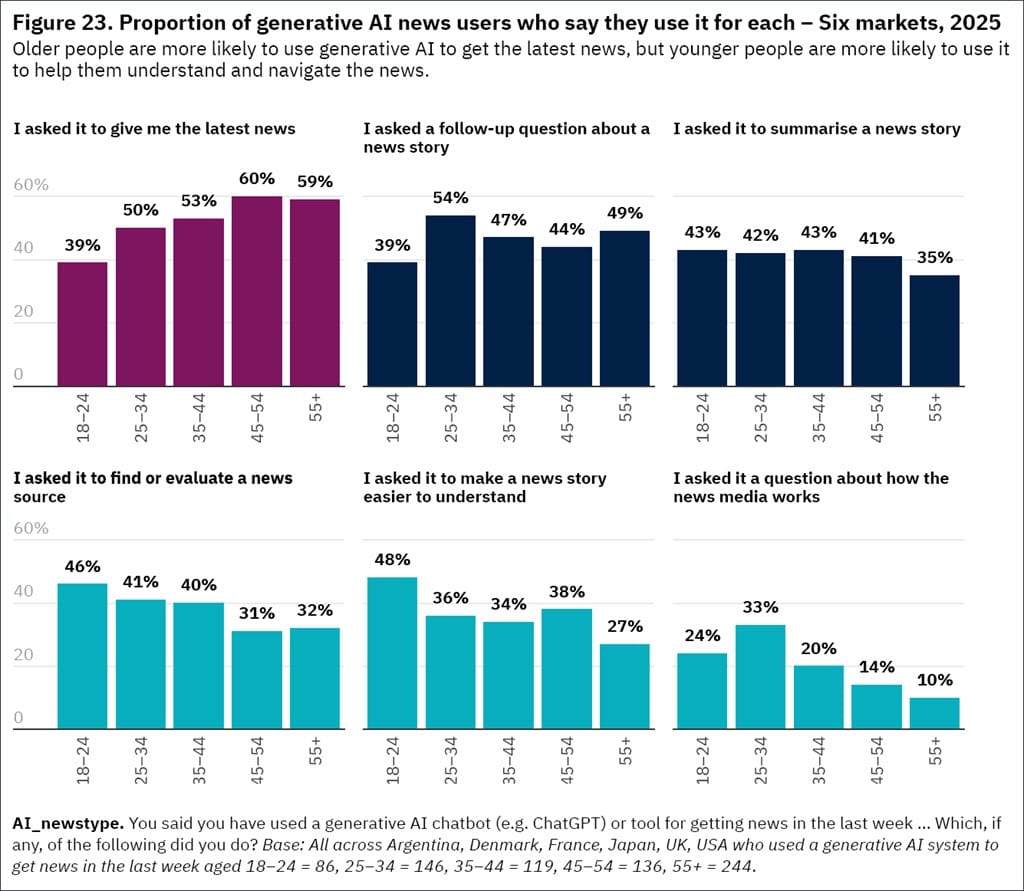
- 15% of 18-24s say they use AI chatbots to access news weekly, compared with just 3% of those 55 and over. Critically, young AI users are not primarily using these tools to get the latest headlines. They are using them to understand, to evaluate sources, and to navigate complexity. Nearly half of this group say they used AI specifically to make a news story easier to understand. That is a striking use case – and one that speaks directly to the legibility problem mentioned earlier.
What this means for organisational communication
The Reuters Institute report is addressed primarily to news publishers. But the implications reach further.
Organisations communicating with younger audiences – whether as employees, customers, citizens, or stakeholders – operate in the same environment. The platforms young people use for news are the same platforms they use for everything else.
The creators they trust for news context are competing for attention alongside organisational messages. The AI tools they reach for to decode a complex news story are the same ones they will reach for to interpret a complex policy announcement or product release.
Several things follow from this.
- Format is not optional. If your communications are text-heavy and published-and-forgotten, you are optimising for an audience that increasingly does not exist among younger demographics. Short, visual, audio-friendly formats are not a concession to short attention spans. They are how Gen Z processes information.
- Relevance must be earned. The report's finding that young news avoiders cite irrelevance more often than older ones is a reminder that "we published it" is not the same as "they received it." The question is whether your content connects to something they recognise in their own lives.
- Personality and trust travel together. The shift towards individual creators is not simply a platform story. It reflects a preference for voices that feel human, specific, and proximate. Communicators who can give their content a genuine human presence – rather than a corporate register – are closer to what young audiences are already seeking elsewhere.
- AI as a communication layer. If young people are using AI to simplify news, they will use it to simplify other communications too. That is both an opportunity and a risk. Well-structured, clearly written content will translate better through AI summarisation. Jargon-heavy, assumption-laden communications will not.
A wider point
The Nieman Lab's coverage of this report observed that young people want their news to be "more fun" – and that framing is not wrong, but it undersells the actual finding.
What has changed is the environment in which those demands are being made, and the alternatives available when they are not met.
For communicators, the lesson is less about chasing TikTok trends and more about taking the question seriously: Does this actually work for someone who didn't grow up expecting to seek news out?
If the answer is no, the report offers a reasonably clear map of what needs to change.
Sources:
- Understanding young news audiences at a time of rapid change (Reuters Institute for the Study of Journalism, 24 March 2026)
- Young people want their news to be more fun, a new report says (Nieman Lab, 24 March 2026)
This article was prepared with the assistance of Claude Sonnet 4.6, Anthropic's advanced AI assistant, which helped with research, drafting, and refining the content. The analysis, editorial judgements, and final text are my own.