

For more than twenty-five years, Amazon has been part of how I shop. I joined in 1999 and signed up for Prime as soon as it became available. For most of that time, the service has been fast, reliable, and largely effortless.
Deliveries turned up when expected, and drivers knocked on the door or rang the bell. Photos confirmed that the items were actually on the doorstep. It was a system that worked.
But over the past few weeks, something has shifted. A noticeable dip in delivery quality has crept in – not catastrophic, but enough to make me rethink how much I can rely on Amazon’s once-dependable logistics.
Across multiple orders recently, a familiar sequence has emerged:
- Drivers now place packages silently by the door and leave within seconds.
- They don’t knock or ring the bell.
- Delivery alerts commonly say “handed to resident,” even when they absolutely haven’t been.
- Doorstep delivery photos – once standard – no longer appear.
I understand the pressure Amazon Logistics drivers face. Their schedules are demanding, and they are often subcontracted, with little control over unrealistic time slots. But the customer sees only what arrives on the doorstep – and increasingly, what doesn’t.
Two recent examples stand out.
The Black Friday Kindle that never arrived
During the recent Black Friday sales, I ordered a Kindle Colorsoft. Simple enough. But on delivery day, what turned up was the wrong package entirely – a child’s toy – with two address labels on it: mine, and someone else's in a town about 30 miles away.
The driver took it back, but the Kindle I ordered and paid for never materialised.
Resolving this – securing a refund, ordering a replacement – took far more effort than it should have: dealing with the service chatbot, finally getting to speak with a helpful human in Amazon customer support, repeated explanations, and no clear answer as to how the mix-up happened.
The convenience evaporated the moment the system stopped being accurate.
“Handed to resident” when it wasn’t
A few days later, two products were due to arrive on Saturday. The alert came through:
Delivered, Parcel was handed to resident.
Except the package hadn’t been. No knock. No doorbell ring. No package.
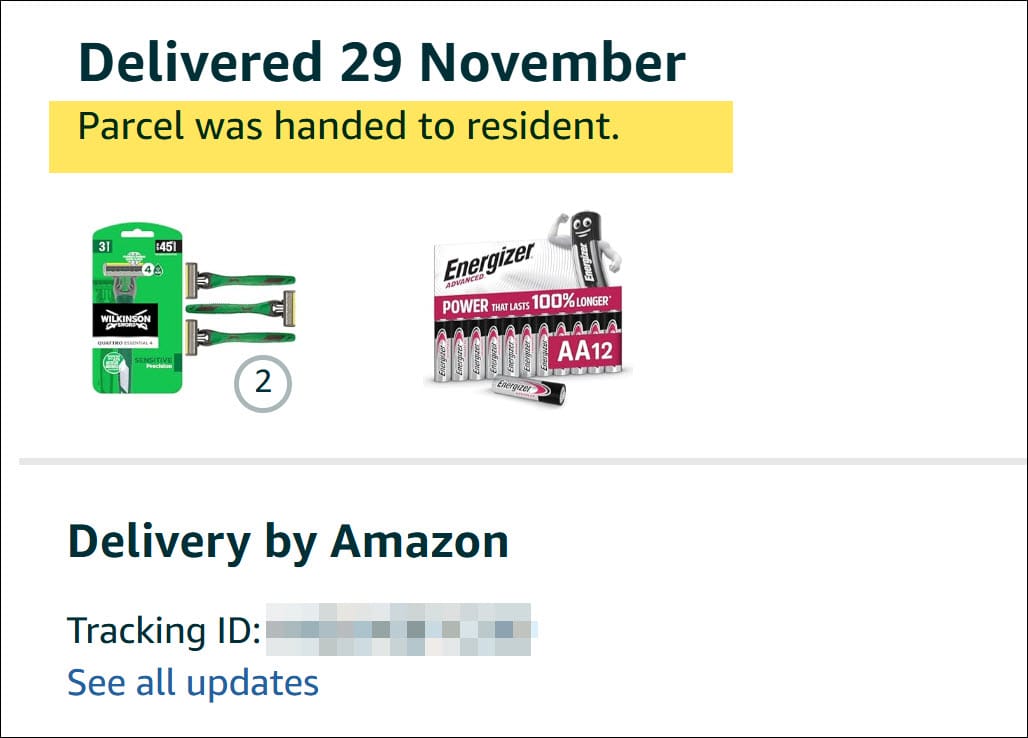
After calling customer support, they refunded the purchase cost. But the next day, a neighbour appeared at the door with them! Had the delivery alert said “Left with neighbour” instead of "handed to resident," that would have been perfectly fine.
Instead, Amazon’s generic, catch-all status masked what had actually happened, creating unnecessary confusion.
Other niggles that add up
None of these alone would matter too much if they were one-offs. But taken together, they point to a service losing consistency:
- Orders arriving days before the scheduled date, with no prior alert.
- Delivery tracking notifications that continue all day, with delivery window timings constantly adjusting.
- Promised delivery windows that simply pass without explanation other than "Sorry, it's delayed."
There is an increasing disconnect between what Amazon tells you and what actually happens.
Why this matters: trust is built on accuracy
This isn’t about convenience alone. It’s about trust.
For years, Amazon’s strength has been its reliability. You believed the delivery updates because they were accurate. You trusted the delivery system because the driver’s photo of the product on your doorstep proved it.
When those signals become unreliable, the whole service feels less dependable.
Misleading statuses such as “handed to resident” erode confidence quickly. They also complicate situations where something genuinely does go missing. When alerts are inaccurate by default, you have no baseline to rely on.
To be fair, none of this necessarily reflects individual drivers. Their workload is intense and their routes tightly timed. The incentives encourage speed, not careful handover. The real challenge is systemic: a logistics model stretched so tightly that clear communication becomes the casualty.
And when communication breaks down, the customer is the one left piecing things together.
How Amazon could improve
The solutions are not complex. Small steps would make a huge difference:
- Bring back doorstep photos as standard.
- Use accurate delivery-status categories rather than the blanket “handed to resident.”
- Enable proper “left with neighbour” notifications.
- Reduce noisy, repetitive tracking messages in favour of fewer, accurate, more reliable alerts.
- Review driver incentives so speed is not the only metric that matters.
Amazon built its reputation by doing the basics well. It can do so again.
A service at a crossroads
My recent experiences are not catastrophic, but they mark an apparent change. Amazon has been the benchmark for online retail for decades. Yet even companies with long-earned loyalty can falter when their systems fail to align with customer expectations.
If delivery accuracy continues to slip, customers will adapt. Not out of frustration, but out of practicality.
After twenty-five years as a customer, I hope Amazon takes this seriously. Convenience still matters, but trust matters more. When the message on your phone doesn’t match what’s happening at your front door, something fundamental has drifted.
To summarise:
- Amazon’s delivery communication has become less reliable, especially with the default “handed to resident” message.
- Recent highs and lows suggest systemic pressure rather than isolated driver issues.
- Trust is undermined when delivery updates lose accuracy.
- Simple improvements in communication and transparency could restore confidence.
Amazon really does need to correct its course. Reliability isn’t just a feature – it’s the foundation on which the entire service rests.