

It is hard to make sense of the current geopolitical moment without feeling a low-level sense of alarm. The world’s attention lurches from one flashpoint to another, yet clarity is in short supply.
Amid wars that grind on, alliances under strain, and fragile economies, we now find ourselves watching US President Donald Trump openly talk about acquiring Greenland – a land-grab framed less as diplomacy than as provocation. What might once have been dismissed as rhetoric now lands in a world where norms feel brittle and restraint increasingly optional.
This is the backdrop as political and business leaders gather in Davos for the annual meeting of the World Economic Forum this week. Yet the contrast is stark. While panels will debate cooperation, resilience, and global stability, the wider world sees hesitation, fragmentation, and an absence of a firm counterweight among many G7 and other leaders.
In that vacuum, uncertainty spreads. People draw their own conclusions: that institutions are weak, that systems no longer work in their favour, and that trust beyond one’s immediate circle is a risk rather than a virtue.
It is against this backdrop of confusion and unease that the 2026 Edelman Trust Barometer lands – and its findings feel less like a revelation than a confirmation of something already taking hold.
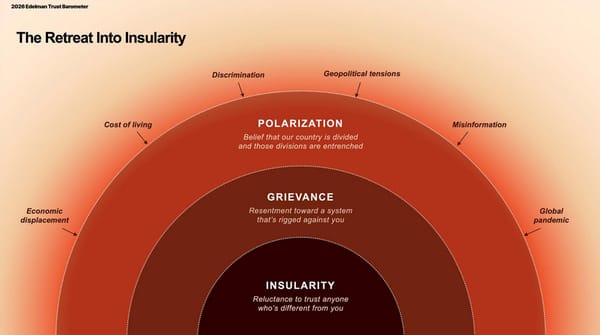
This year's report describes a world that is not just polarised, but increasingly insular.
Under sustained pressure from economic anxiety, geopolitical tension, misinformation, and rapid technological change, people are narrowing their circles of trust. Rather than engaging with difference, many are retreating toward what feels familiar, safe, and aligned with their own views.
Edelman’s data makes the scale of this shift clear. Seven in ten people globally now say they are hesitant or unwilling to trust someone who differs from them – whether in values, beliefs, sources of information, or background. This mindset cuts across age, income, gender, and political orientation. Insularity is no longer marginal. It is mainstream.
For leaders and communicators, that matters more than almost any other finding in the report.
When trust turns inward
One of the most striking patterns in this year’s Trust Barometer is where trust now sits.
Confidence in shared institutions – governments, national leaders, major media – remains fragile. At the same time, trust has strengthened in much smaller, more immediate circles: colleagues, neighbours, direct managers, and employers. Globally, my employer is now the most trusted institution.
This shift has profound implications for leadership communication.
In an insular environment, messages are not simply received or rejected. They are filtered through identity, grievance, and perceived alignment with “people like me.”
Why insularity is a leadership issue
Insularity is not just a social or cultural concern. Edelman’s data shows it has direct organisational consequences.
People with an insular trust mindset are more likely to:
- Withhold effort from leaders they perceive as “different”.
- Avoid collaboration across value or belief differences.
- Resist innovation and organisational change.
- Support exclusionary or protectionist responses, even when those raise costs.
In other words, insularity quietly undermines productivity, leadership credibility, and progress from the inside out.
This is the context leaders are now communicating in – whether they acknowledge it or not.
A shift in what people expect from leaders
Edelman does not argue that leaders can talk their way out of this environment. Instead, the report introduces the idea of trust brokering.
Trust brokering is not about changing minds or forcing consensus. It is about enabling cooperation across differences. That means acknowledging disagreement rather than smoothing it over, translating perspectives so people understand one another’s realities, and focusing on shared goals rather than perfect alignment.
Notably, when people are asked what builds trust in highly divisive moments, the strongest response is not silence or taking sides. It is encouraging cooperation without inflaming division.
That is a subtle but important recalibration of leadership communication.
Why this matters for communicators
In an age of insularity, leadership communication is no longer just about clarity, consistency, or persuasion. It is about helping people work together when trust is thin, differences are sharp, and shared reality is fraying.
That places communicators much closer to the centre of leadership itself – shaping not just what leaders say, but how they listen, engage, and navigate disagreement.
For now, one conclusion stands out: Insularity may feel like a defensive response to uncertainty – but left unaddressed, it becomes a quiet brake on leadership, trust, and progress.