


What does a modern Chief Communications Officer really do?
It's a question many in our profession still find difficult to answer with clarity. Senior communicators often shoulder responsibilities that cross strategy, culture, reputation, risk, behaviour, and leadership – yet much of the role remains unseen, even misunderstood.
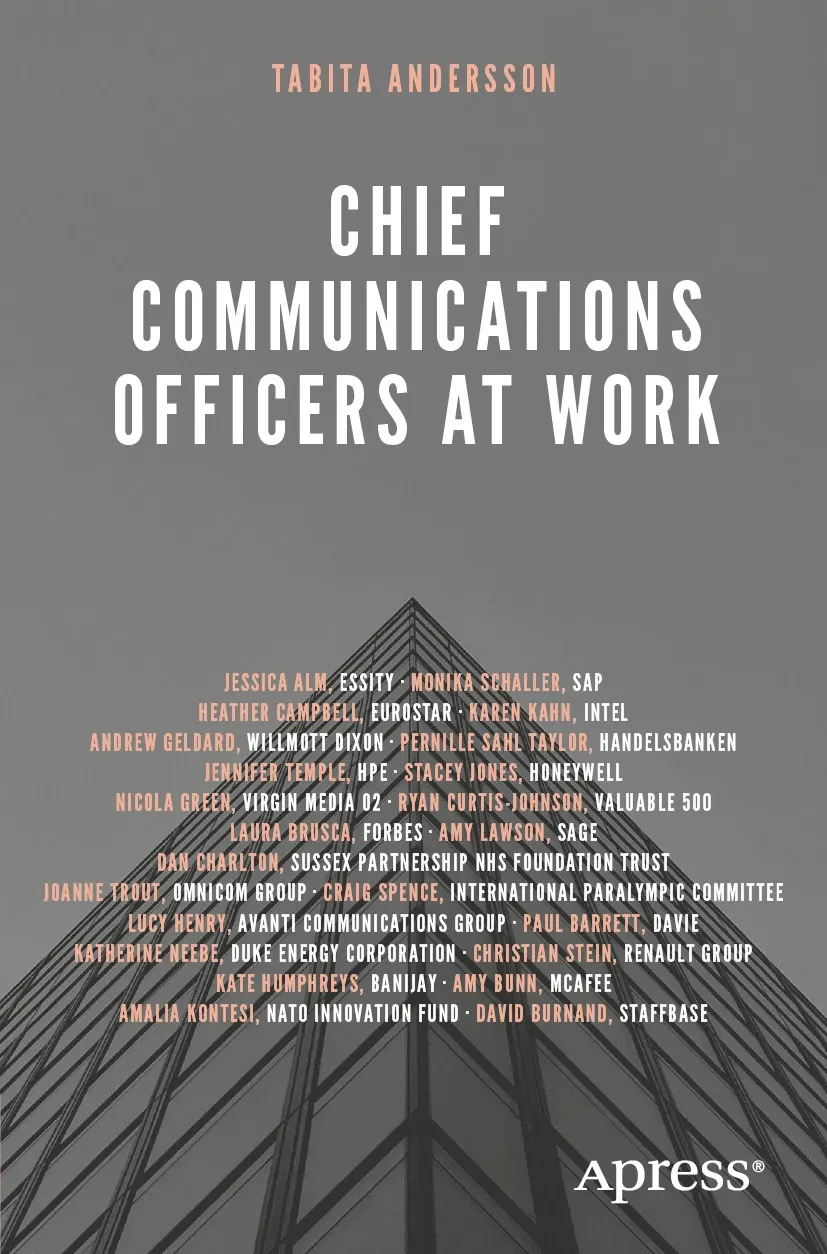
This is why Tabita Andersson’s new book, Chief Communications Officers at Work, is such a welcome contribution. Rather than offering theories or toolkits, she brings together 23 CCOs from some of the world’s most recognisable organisations and lets them talk openly about their work. What emerges is a vivid, honest and consistent picture of what it means to lead communication at the highest levels of business.
In the interest of transparency, I should note that I’ve known Tabita for 25 years, and we’ve worked together a number of times during that period. Her clear thinking, curiosity and practical leadership style shine through in how she brings these conversations to life.
Across industries as varied as healthcare, telecoms, semiconductors, construction, finance and automotive, the same themes come through time and again in the book – critical thinking, courage, curiosity, business fluency, and the ability to join the dots before others see the pattern.
Several contributors bring this into sharp focus:
- Virgin Media O2's Nicola Green distils the role with refreshing simplicity: a CCO manages the business's reputation and brings the outside world into the organisation, ensuring decisions reflect what stakeholders value and expect.
- Intel’s Karen Kahn talks powerfully about shifting from activity to impact, advocating a disciplined approach – fewer things, done better – supported by a clear sense of what the organisation is trying to achieve.
- Renault Group’s Christian Stein, operating across more than 100 countries, emphasises extreme curiosity and the importance of understanding how the business actually works, even as AI accelerates many aspects of the role.
- And within the NHS, Dan Charlton shows how communication, patient experience, and governance can sit side by side, demonstrating that clarity, empathy and tone are vital to public trust.
What unites these leaders is not their sector or organisational structure, but their mindset.
CCOs are at their most valuable when they are brought into decisions early; when they act as integrators rather than broadcasters; when they help leadership teams think clearly before they act; and when they focus on coherence over noise.
More than one contributor notes that reputation is shaped not by how much you say, but by what you decide not to say.
Why this book matters now
We are living through a period in which the expectations placed on communicators are shifting at speed. AI is changing workflows; employees are more vocal and values-driven; misinformation spreads easily; leaders are under intense scrutiny; and organisations must operate with a degree of transparency that would have been unthinkable a decade ago.
In that environment, the CCO is no longer a functional specialist – they are a strategic partner, a risk sensor, a cultural barometer and a guide for how organisations show up in the world.
The scale of organisations represented underscores this point. Interviews span Intel, SAP, Renault Group, Virgin Media O2, Honeywell, Sage, Duke Energy, Handelsbanken, Omnicom, Avanti Communications, Willmott Dixon and more. These are leaders operating in complex, often high-risk environments where misalignment is costly and clarity is essential.
Available in paperback and digital (PDF and Kindle) editions – the latter format would make annotation easier – the quality of insight revealed in Tabita Andersson's conversations is rich, human, practical and often quietly profound.
The book's structure - 23 chapters - lends itself naturally to an audio version. I can imagine listening to each conversation as a podcast while driving or on a train. I wonder if this is on the publisher's mind as an additional way for people to experience the stories?
Three things I'm taking away from this book
1. The CCO’s value lies in anticipation, not amplification.
Communication leadership is less about generating output and more about seeing around corners, connecting signals and helping organisations act before issues escalate.
2. Clarity is a leadership behaviour.
Whether speaking about crises, culture or business strategy, the interviews reinforce that communicators thrive when they translate complexity into something human, understandable and actionable.
3. The CCO role is expanding – and becoming more human.
AI may speed up tasks, but judgment, empathy, curiosity and trust remain at the core of effective communication. The CCOs in this book remind us that influence grows out of relationships, not deliverables.
For anyone practising communication today – whether an aspiring CCO, a seasoned adviser, or someone curious about how reputation, culture and strategy really connect – this book is well worth your time. It is a thoughtful reminder that modern communication leadership is not about volume but about value, clarity and intent.
Highly recommended.
Chief Communications Officers at Work
Author: Tabita Andersson
Publisher: Apress
Publication date: 29 October 2025
Softcover ISBN: 979-8-8688-1855-4
eBook ISBN: 979-8-8688-1856-1
Edition: First Edition
Language: English
Print length: 295 pages
Available from the publisher, from Amazon, and from other sellers of good books.