

At the end of January, the Public Relations and Communications Association (PRCA) published a proposed new definition of public relations.
It’s ambitious. It positions PR as a senior strategic management discipline. It talks about legitimacy, trust, long-term value, volatility, risk, and the complexity of modern operating environments. It explicitly references the information ecosystem and the role of AI. It is designed to move the conversation beyond publicity and press releases.
There is a growing sense that the profession does need a more contemporary definition. But here’s the question that lingers:
Can any definition really claim to speak for all of us?
Ask Google what PR means
If you search "definition of public relations," you’ll find no shortage of answers.
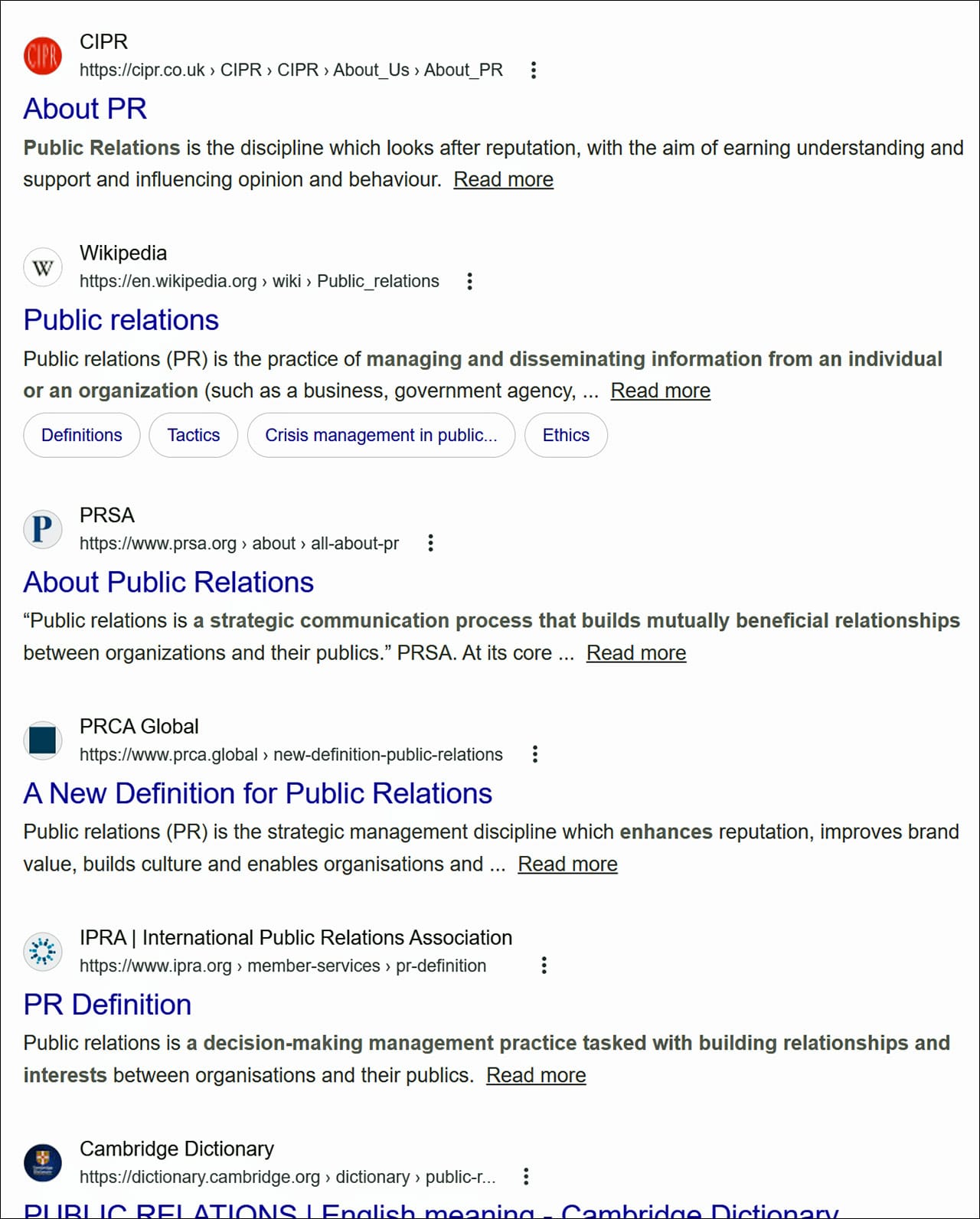
Professional bodies such as the Chartered Institute of Public Relations (CIPR) in the UK, the Public Relations Society of America (PRSA), and the International Public Relations Association (IPRA) define it in broadly similar terms: a strategic communication process focused on building mutually beneficial relationships between organisations and their publics.
Dictionaries simplify it further – the activity of maintaining good relationships with the public.
Each of these definitions reflects a different lens: reputation, process, relationships, goodwill. None is wrong. But none is universally adopted.
And that matters. If a profession cannot explain itself clearly and consistently, it leaves space for others to define it instead – often in ways we do not like.
What the PRCA has done well
The PRCA’s proposal deserves credit for leadership.
It recognises that the world in which public relations operates has changed. Organisations are judged not just on what they say, but on how they behave. Reputation is inseparable from legitimacy. Communication is inseparable from governance. And information now flows through algorithmic systems as well as traditional media.
The draft also responds to consultation feedback, explicitly strengthening its emphasis on ethics and responsible practice. That’s important.
Most significantly, the PRCA firmly places PR within the realm of strategic management. Not a delivery function, nor a tactical support service, but a discipline that advises leadership, interprets complexity, and shapes long-term organisational health.
That’s a framing many senior practitioners will recognise as accurate.
Where the challenge lies
The issue is not whether the PRCA’s definition is good. It is. The issue is whether it can become more than a PRCA definition.
At present, it represents the view of one professional body and its members. Meanwhile, other bodies – national and international – retain their own formulations. Academic texts add further nuance. Dictionaries default to simpler interpretations.
Fragmentation weakens clarity – and clarity underpins credibility.
Clients hear one thing. Students learn another. Employers see a third version. The public sees something else entirely.
Is a universal definition even possible?
Perhaps the mistake is trying to compress everything into a single paragraph.
Other professions often operate with two layers.
Take medicine, for example. Encyclopaedia Britannica defines it as “the practice concerned with the maintenance of health and the prevention, alleviation, or cure of disease,” a concise and widely understandable description.
But the depth of medical practice sits in its governing standards, ethical codes, clinical training, specialisms and regulatory frameworks. The definition remains portable; the principles and practice carry the weight.
Perhaps public relations could benefit from a similar distinction. The PRCA has, arguably, already laid that groundwork through its combination of a core statement and supporting principles.
What remains missing is shared stewardship.
If a body such as the Global Alliance for Public Relations and Communication Management – part of whose stated mission is "to unify the public relations profession" – were to convene major associations, including the International Association of Business Communicators (IABC), CIPR, PRSA, PRCA and others, could we arrive at a single, concise definition supported by shared principles?
It would not be easy. Consensus-building rarely is. But if unification is the goal, agreeing on how we define ourselves would seem a logical place to start.
Without some form of alignment, we will continue to have multiple “official” definitions co-existing in parallel. That does little to strengthen professional identity.
A possible starting point
If we were to aim for a short, portable definition that reflects contemporary practice, it might look something like this:
Public relations is the strategic management of relationships and reputation between organisations and the publics on whom their legitimacy and long-term success depend.
That sentence is not perfect. No sentence will be.
But it captures strategy, relationships, legitimacy, and sustainability – without becoming a manifesto.
The real opportunity
The PRCA has done something important. It has reopened a conversation the profession revisits every decade or so.
The last major attempt at redefinition, led by PRSA in 2011, generated global engagement and debate. I wrote about it at the time. The energy was there. The universal adoption was not.
Perhaps the lesson is this:
That requires less ownership and more partnership.
The PRCA has taken a step forward. The question now is whether others will join it – not by replacing their own definitions defensively, but by asking a simple question:
What would we be proud to say, together, that public relations actually is?
References:
- PRCA: A New Definition for Public Relations
- CIPR: What is PR?
- PRSA: About Public Relations
- IPRA: PR Definition
- About Global Alliance
- Encyclopedia Britannica: Medicine / Definition
- FIR #496: A Proposed New Definition of Public Relations Sparks Debate (For Immediate Release podcast, 13 January 2026)
- Have your say in redefining public relations for the modern age (NevilleHobson.com, 21 November 2011)